Tuesday, August 25, 2020

A Book I Read In One Night

 Find Layla, Meg Elison


    I stayed up late reading this one. It was an Amazon First Reads that seemed ok. As much as I hate the word "unputdownable," it applies here. 
    Layla is a neglected 14 year old who loves science. She cares for her little brother, even though he annoys her sometimes, and gets good grades in school. She, like most neglected children, has developed a solid set of protective measures- forging her mother's signature, covering up her home life. She's aware that her life is bad but doesn't have any tools to change it, only those to mask it. She's bullied and teased and copes with science.
    After going viral with a video of her biome, a dark apartment with significant water damage, infestation, and filth, Layla runs away. Her world is collapsing around her. She's a child who is more afraid of the unknown than of the known squalor. She's also a resourceful young woman.
    Now, this is a YA novel, so it's not necessarily going to be believable (although some of y'all don't know just how badly neglected and abused children are treated every day), and it might not wrap up in a tidy package. But here's the thing. It gives a kid credit. And it also shows adults failing kids. And it shows an incredible resilience in children. And the weight some children bear and adapt to. Layla compares herself to both Dr. Jane Goodall and the gorillas Dian Fossey studied.
    Despite the heavy subject matter, this is a very quick read. There's no fluff. I think it's good for adults to read to kind of check our assumptions about neglected and abused children, and also for middle graders to read to see the struggles their peers may have that are hidden.
    

Monday, August 24, 2020

Another Immigrant Song

 A Woman Is No Man, Etaf Rum


    I mentioned way back in Americanah that I took a class on immigrant literature in college. Turns out that I seem to appreciate these novels more and more each year. What Rum has done in these pages is craft an intimate portrait of the complexities of leaving one's home for a new one.
    A Woman Is No Man collects the stories of a handful of Arab women, centered around Isra. Teenage Isra lives in Palestine and is contracted to marry a man living in New York. Her relationship with her mother is complicated and distant, even when they live together. In New York, Isra follows the lead of her mother-in-law, Fareeda, following the cultural rules as she understands them. Much to Fareeda's disgust, Isra gives birth to four daughters. Isra's husband, Adam, resents her more with each subsequent girl as he also spirals down under the pressure of his familial role as eldest son. Deya, Isra's oldest daughter, is the focus of the later tales as she uncovers the truths about her family's life before her parents died. Sarah, Fareeda's only daughter, befriends Isra and later Deya and serves as a catalyst for their story arcs.
    So, of course, a story about immigrants is going to discuss the balance between assimilation and honoring culture. It's going to talk about the otherness of no longer being a countryman and not belonging to the new home. There's expectation, shame, loss, possibility. And a story about women is going to delve into the roles of women in societies.
    What Rum does nicely, by telling multiple stories, is illustrate that there are no easy answers for these women. All of them lose their home in some sense, by military force, by arranged marriage, by escape, by finding the truth. And, mostly, none are satisfied. It's both very real and very sad.
    It's easy for an outsider to think there are easy solutions to difficult situations. Battered women should leave their partners. Child brides should run away before they are married off. "Why doesn't she just ... ?" Rum pulls at those threads and shows that, even the right choice, can lead to terrible consequences. And that, I think, is the universal truth revealed in these pages.
    A Woman Is No Man is heavy, tragic, and very lightly hopeful. Its characters are sympathetic, even when you are angry with them. It's frustrating and painful. It's one you should read.

Thursday, August 13, 2020

Short List of Good Books from the Interim

I don't have the time or desire to pore over all the books I read in the gaps in my timeline, but here are a few titles that I enjoyed and think people should read.

YA:
The Other Half of Happy, Rebecca Balcarcel
The War that Saved My Life, Kimberly Brubaker Bradley
The Girl Who Drank the Moon, Kelly Barnhill
A Snicker of Magic, Natalie Lloyd (if you like Because of Winn-Dixie)

Lighter Side:
Evvie Drake Starts Over, Linda Holmes
Holly Banks Full of Angst, Julie Valerie
Daisy Jones and the Six, Taylor Jenkins Reid (like Behind the Music in book form)
The Vine Witch, Luanne G. Smith

Myths:
Gods of Jade and Shadow, Silvia Moreno-Garcia
Circe, Madeline Miller

Alternative History:
His Majesty's Dragon, Naomi Novik (Temeraire series)

Racism in America:
The Hate U Give, Angie Thomas
An American Marriage, Tayari Jones
The Nickle Boys, Colson Whitehead (I sobbed at the big plot twist)
The Blood of Emmett Till, Timothy B. Tyson

Ok, so some of these fall into multiple categories, but that'll do for now.

Thursday, August 6, 2020

Reese and My Sister Made Me Do It

Yes, it's been a long time since I typed up anything about what I'm reading. Don't worry, I've been reading. And listening. And logging titles in my Goodreads. But I'm back here talking about books because ... well, my sister asked me to and I get more out of this than I do ticking a box on a Bezos app.


As usual, I didn't read any reviews before diving into this novel, which the aforementioned sister also told me to read. It has an overall high score on a few platforms, but the very first review of Goodreads is a funny 1-star. It seems the reviewer doesn't do much self-reflection on her reactions to what she reads and actually demonstrates one of the main themes of the novel- the narrowness of (white) suburban life. The reviewer talks about how Ng lays the story out as black/white good/bad, without any apparent connection to which characters also live that way. The irony seems lost on her completely. 

So, the overarching story- a misfit living in a staid community- isn't new. It reminded me of Edward Scissorhands in a lot of ways. And, at times, I felt like it was too ambitious, trying to cram in too many conflicts and hot-button topics. But, Ng pulls all the threads together to set off the Big Finale. I imagine it like a person holding the tails of several helium filled balloons, each floating at a slightly different altitude, each with a different length of ribbon trailing. And Ng ties all those strings in a knot, but leaves a ragged, untidy tail at the very end. And here is one thing I really liked about the book.

When I'm in the mood for fluff, I want an easy story. I want people to fall together over time and live happily ever after. When I'm in the mood for a challenge, I like books like Little Fires Everywhere. There's no explicit happy ending for anyone. So I'm left to decide ... Does Pearl ever meet her grandparents? The Bryans? Does Izzy follow Mia's footsteps and become a great artist, or a poor drifter scraping by on talent? Will Lexie return to Shaker Heights upon graduation? Does Elena ever learn the truth about all her suspicions? Is the Richardson family every reunited? What kind of life does Pearl pursue? Does Mia ever put down roots? How does she handle Pearl becoming an adult? So. Many. Questions. And I feel like Ng has done well enough introducing me to the characters, that I have an idea of which path they will take and whether they will have regrets.

And while the novel tackles many topics like racism, classism, trans-racial adoption, immigrant experience, death, and abortion, I think the overall theme is regrets. Each character, even the minor ones, have a moment on which their lives balance and every choice they make after is based on whether or not they regret that initial one. Like Mia tells Lexie, they just have to carry it.

One writing choice I find interesting is when Ng calls the white suburban women by their first names and when she calls them Mrs. Lastname. It definitely sets a tone for the reader to distance themselves from these characters for large parts of the book, especially when they are doing the wrong thing. But it's also a snapshot into that suburban life. The rules, propriety, and formality. Last names surround these women and protect them from revealing vulnerabilities. Mrs. Richardson is a successful, orderly, pragmatic, and reasonable woman. Elena is a friend, a young woman who had to choose between safety and romance. Also interesting is that each of the Richardson children go by nicknames, the only characters to do so except for a bit parts played by college roommate, Betsy-cum-Elizabeth, and a professor's partner.

Several reviewers comment that they feel manipulated by Ng's storytelling, but also that the omniscient narrator is unsettling. They want to decide who is good and who is bad and simultaneously want the story from a single perspective. That, in itself, is a thread I'd like to pick at. Perhaps there is some resistance to feeling sympathetic towards a character they feel is immoral. Maybe there is some dissonance connected to the rule follower making several unethical moves. I didn't feel like any one character was the good guy or the bad guy, with the exception of Pearl, who is just batted about on the waves of everyone around her mostly. For me, it seems like the characters are all flawed, all make serious mistakes and bad choices, and then ... here's the message I think Ng is trying to give us ... they continue on with life, carrying that weight.

Saturday, June 2, 2018

A Tale of Two Suspense Novels

Hello and apologies for my silence over the last months. I promise I have been reading and talking books and writing, just not here. That last one really hurt. I'll work on a summary of some of those from The Great Silence, but today I'm tackling the most recent titles.

One of my girlfriends kind of got me on a suspense kick with Blood Sisters, which I enjoyed and texted her more than once with "wtf?" I requested a few from some library sources I have and surprise! two became available the exact same day. It's hard not to compare them, so I'm going to.


Both of these were enjoyable, interesting, fast-paced, twisty- all the things you want in a thriller. But I have to say, A.J. Finn did a better job in crafting the story.

The Woman In the Window is the Hitchcockian-noir story of an agoraphobic psychologist who spies on her neighbors and witnesses something terrible. It leans on the unreliable narrator structure in a way that doesn't make me hate Anna, the protagonist. Yes, she drinks too much and mixes it with her meds (tsk, tsk, Dr. Fox), but I found it less annoying than the same ploy in The Girl On the Train. Some of the twists were predictable, some I expected but not from whom.

The Couple Next Door follows a couple and a detective in the days after the couple's infant daughter is abducted while the parents are at a party next door. It's definitely a unique premise that could spawn some thought-provoking conversations among parents (and probably lead to a bunch of pearl-clutching and sanctimommying, but let's stay positive for a few minutes). The title suggests much more interaction with the couple hosting the party, but they barely register. The husband is literally only in the first scene. And their big secret adds almost nothing to the plot. Although, with a cliffhanger ending, perhaps Shari Lapena intends to delve more into their lives. It's a page-turner, but in my opinion, falls short of its counterpart today.

- Finn's characters are more engaging. We experience enough of Dr. Fox's interior life to get a feel for who she really is. We are told what Marco and Anne Conti and Detective Rasback are thinking, not shown.
- Finn's crime is the focus of the story, the conflict we want to be resolved. The missing baby is almost secondary to Lapena's story. More time is spent on the possible reasons Cora is gone than dealing with the aftermath of a baby vanishing. More time is spent watching the least sympathetic parent, which makes it hard to find someone to like.
- Finn propels the story from the first-person point of view. This, to me, makes all the biggest difference. The reader gets caught inside the fragile mind of one woman. You feel trapped in her obsession because she is the only one revealing the plot. I kept thinking how much more suspenseful the Contis' story would have been if only one of them had been telling it. Instead, we bounce around and have an omniscient third person telling us how everyone is feeling but never revealing intimate thoughts through action or inner dialogue.

Lest it sound like I hated Couple, I admit I will share it with friends. If you like suspense, it's a good, quick read. It's a good story poorly told. It's a rough draft that still needs editing.

So, those are the two books I read this week. I've got one more suspense novel in my queue before I switch things up.

Others that I won't be reviewing now but finished:
Charlie Bone series by Jenny Nimmo- decent. Not the world-building and complexity of Harry Potter, but an enjoyable child-discovers hidden talent/family secret arc.
Plantagenet series by Phillippa Gregory- reliably good. I enjoy Gregory's research-based imaginings of the lives of women in history. Particularly, I love that different women recounting the same events as friends and as enemies all have my sympathy. These books are the precursors to the wildly popular Tudor books from a few years back.
The Road to Jonestown about the history of Jim Jones' Peoples Temple. Though I took a course in college that focused on Jonestown, I learned so much from this. Warning- the back pages are full of very graphic images.
Hell's Princess- a disappointing offering from a well-respected true crime researcher. Belle Gunness lived on her murder farm in the small town where I grew up. While I did learn more from the book than I picked up at the county museum display, I was put off by the reliance on "yellow journalism" for research while also talking about how unreliable media was at the time.
The Light of Fireflies by Paul Pen. Wow. I should actually write a whole review of it. I wasn't expecting the thriller aspect of this one because it starts out more like book club lit. It's just a really compelling read. The translation to English is skilled and poetic. I highly recommend it.

That's about all the summarizing I can handle today. I downloaded several new titles on World Book Day and put in requests for 13 new books at the library, so there's more material to come. In case you missed it, I did a roundup of titles for the summer over at the Destin 30A Moms Blog.

Friday, July 14, 2017

The Book That Almost Broke My Blog


Trans, Juliet Jacques

I've been avoiding this post for months. I even read an entire series since this one, but I want to chronicle my reading in order. So, it's time. This isn't going to be easy.

I mentioned previously that I am trying to read more first-person narratives. And my desire for an authentic storyteller is hipster level. Enter, Ms. Jacques.

To begin, I'm going to share a little of my experiences with trans people. I went to a state school that had a surprisingly large group celebrating and supporting the LGBTQ+ community. Sort of. Those four years I was around people who explored, questioned, and experimented with their identities in many ways. It was at a drag pageant on campus that I learned an acquaintance from high school was performing. My favorite nightclub had drag shows. The restrooms might have had gender signs, but nobody paid attention to them. Honestly, it was one of the few places where I felt like I could just be me, safely, and nobody cared what that meant.

My senior year I moved into a small apartment complex that shared a parking lot with another. The two buildings faced each other. Naturally, many of us became friends. It was an eclectic group of people. It was home. Among the maybe 3 dozen people living in those two buildings, were David and Shel. David was David most of the time, except when he was Kenya- a crowd pleasing queen. It was easy to know which persona was present. Kenya was a character David became. Shel was different. Shel was born male and tried to live as a woman sometimes. It was a painful struggle for him (his chosen pronoun). He had tried hormone therapy in the past but didn't continue it. He hated being a man and was terrified of being a woman. Today he might call himself genderfluid, a term we didn't have back then. The point is, these were people I saw daily. They were friends. They were my most intimate experience with trans identities. I took that for granted.

Now to the book. Jacques has admitted that she didn't want to publish a memoir, a fact that is pretty obvious to me. It's a shame that the only story a publisher wanted to touch was this one because it is not well-written. To be clear, my problems with the story aren't with the overall content. It reads exactly like a book the writer never wanted to pen.

For a memoir, Jacques shares very little of her interior life. There's occasional discussion of depression or the anxious feelings she had when shopping. But mostly it's almost a third person limited narration of events of her life. There are detailed paragraphs about soccer/football plays and many references to the music scene she was into. Both were completely lost on me and did nothing to help me relate to the person behind the story. I can't blame Jacques for this, since she didn't want to write a memoir. But at the same time, I wonder why she bothered with publishing it.

The other thing I didn't care for was the complaining about how hard it was to transition. Remember, I had a friend who was never able to, even though he wanted to. Knowing how difficult and expensive it is for people here, having to live as a woman for a year before having confirmation surgery seems like a pretty privileged complaint to me. It's not a competition, of course, but if that's the hardest thing you have to overcome ...

There are things I really liked about the book, too. Just not the memoir part. Jacques weaves in a little trans theory and politics. She talks about how limited trans lit is- the same thing her own book suffers from. She gives very limited space to her life before transition, which I have deep respect for. If people want to get off on that kind of stuff, they can read Middlesex. I liked that she didn't write a sensational story, that there was no huge battle with her parents or a suicide attempt.

It's hard to give this one a rating. My feelings about it are too mixed up. Most notably is that, as a cis-woman, it's not really my place to rate Ms. Jacques' experience. The obscure scene references and distant storytelling are not good writing, in my opinion. At the same time, I realize that she didn't have many options. I'm glad I read the book, but I'm not sure I'm glad she wrote it.

Sunday, March 12, 2017

Dreamland Burning


Dreamland Burning, Jennifer Latham

Brace yourselves for a bit of a rant that isn't directly about this novel and yet is. It's a re-hashing of my thoughts on The Help, so if you are tired of that one, feel free to skip this entry.

The concept of this novel is good. It has so much potential- two mixed race teens separated by decades, united by a corpse. There's a hint of mystery, some interesting historical detail, and a whole lot of trying too hard.

I'll start with the heavy-handedness of the social issues that create the tension of the stories. Considering that the central events revolve around a race-line conflict that left the black areas of Tulsa in ashes, we don't need to be hit over the head with "racism is bad, mkay?" And the supporting character, the girls best friend who also happens to be an asexual guy, is the weakest conjured sidekick I can imagine. He's got a cool car and he's asexual. He's asexual. Oh, by the way, he's asexual. He's also black- which would be much more pertinent to the main story- but we'll keep focusing on his sexual identity, regardless of how little it progresses the story. There are no situations where it's relevant, except to really make the point that their friendship is truly platonic. So it comes across as a detail that was just thrown in to make the whole novel more diverse. Same with the other teen's native mother, although her background gives a little bit of structure and context. We also get a homeless man and an addict as secondary or even tertiary (man, I love that word!) characters to round out our coat of many colors. And this, my friends, is also where I get my knickers in a knot.

This book is written by a white woman. Now, don't get me wrong, I love intersectional feminism and want WW to be good allies. Every important character in this novel is a Person of Color. All of them. Then why is Nice White Lady the one telling it? What insight could she possibly have into the everyday lives of mixed-race Tulsans that we couldn't get from, I dunno, actual POCs? Maybe, just maybe, this isn't her story to tell. Maybe, she could've told it from a different perspective that she can actually relate to better, and, therefore, made it more believable.

Elvis didn't invent rock n' roll.
Aibileen should've written the book, not Skeeter.
Miley wasn't the first to twerk.
The list goes on.

Now, without trying to sound like a hipster, I want authenticity in a storyteller. That doesn't mean that no white person can ever write a character of color, no straight person can ever write a queer one, no man can ever write a woman. But for the love of Benji, can we please, as white people who like to write, please take a step back? Can we please not assume we can tell these stories better than the people who have actually lived them? And, if we insist on still telling them, can we please do some actual first-person research? Maybe not try to frame an entire novel as a way to fix the social injustices that we are actually largely (if not totally) responsible for? I mean, can you imagine if Jodi Picoult tried to write Push? That's pretty much how this one reads.

And, let's be honest, the two main characters are heroes for different reasons. The young man, who passes as white but is called half-breed by the utterly one dimensional bad guy, who is not in touch with any of his native ancestry, swoops in during a tragedy to rescue a couple of black people that he happened to actually talk to. Thank you, White Savior. We're all so super grateful that you went from punching a guy and getting him worse-than-lynched to carrying beaten black men to a sanctuary. Really, it's great that this guy had a change of heart and did some pretty brave acts on that one single night, but ... then he gets to vanish. He's done his part. Give him a cookie. The young woman, who benefits from her white daddy's public standing, lives in her ivory tower, and is so far removed from not only her black ancestry but also even middle class life, gets to pin a rose on her own nose because she finally has empathy for a homeless man after he dies. I get it. They're kids. They haven't experienced the world outside of Tulsa. It's just so ridiculous that both of them have these massive changes of perspective seemingly overnight. It's so insincere and they have hidden in their privilege for so long I find them hard to like.

I could probably ramble on for several more semi-coherent paragraphs, but I won't. This story is weak and ambitious. It's not particularly well written. It's not challenging or engaging. I did read the whole thing, so it's better than The Orchardist. It gets credit for giving me something new to research- the Tulsa race riot. Dreamland Burning gets a lowly one and half Marias.

P.S. I'm trying to consume more works by outsiders. If you have a recommendation, drop a comment, please.


Friday, February 17, 2017

The Fiery Cross, Outlander book 5


The Fiery Cross, Diana Gabaldon

It didn't take me quite this long to read book 5, but sometimes it felt like forever. Still, I've found a moment to write about this one.

If you don't know about Outlander, it's hard to describe. It is a mix of historical fiction, war, romance, fantasy/sci-fi, and ladyporn. Each novel is really long. There is a LOT going on in this story, and Gabaldon does a fine job of weaving a very intricate tale.

Back when I read A Book That Scares Me, I mentioned an incident with my friend. I'd been reading the first three installments of the Outlander series and I told her that, frankly, I was tired of all the rape. So I was going to take a break and pick up a new series. Unfortunately, it was the Girl With the Dragon Tattoo series, so *spoiler alert* more rape.

Well, when I came back to book 5, really the books are good but you can't just plow through the whole series, I told the same friend that I was starting it. I said something about how the title sounded like something about the Klan not clans (in fact there is a book about the history of the KKK with the same title) but wasn't. Well ... there aren't any white sheets involved, but it does lay the historical groundwork for what would become the white supremacy group we all love to hate.

The story- how many ways can colonists barely escape death? That could be the subtitle of this one. Fortunately for pre-Revolutionary mountaineers, Claire has brought her modern medical expertise back and is brewing some form of penicillin, making luxurious soap, and birthin' babies all over the Carolinas. At least no one kills a bear with a knife in this one.

I don't want to give it all away, but just as I was about to shelf Cross and turn to something else, BOOM! She tries to kill one of the main characters! You know when Jamie and Claire are going to die (or do we?), but there are children and grandchildren and tenants that are still a mystery. And let me say, it isn't an accidental misfire. Dude is hung as a prisoner of war. Well, that got my attention and I dove right back in.

This is not the kind of series where you can pick up any. You need to start at the beginning (a very good place to start). If you're like me, you'll start googling historical events you never learned in school, like the Jacobite rebellion. And, honestly, one thing I enjoy about the series now that they are in the Carolinas is that I'm familiar with the places and the names. If that's your thing, too, then keep at the series. If not, I can probably summarize seven bazillion pages for you over a cup of coffee.

The Fiery Cross runs along my other Outlander recommendations of four Marias.


Tuesday, November 1, 2016

Americanah


Americanah, Chimamanda Ngozi Adichie

I could probably take a few days to write this review. I could turn it into a full-on book report cum sociology conversation. But that's not what you are here for, so I'll curb those desires. A little.

This one took me a while to get into. I don't know if it was life circumstances or what, but I almost didn't renew after two weeks. I almost didn't finish this book. But I picked this book as a conscious effort to read more books by people of color, especially women. So, I kind of had to finish it. And, once I hit a certain point, one I can't really define, I didn't want to stop reading. Full confession, with just 20-ish pages left, I put my tablet on my bedside table and spent a sleepless night worrying that one of the characters might die. You might say I am invested in my stories.

Americanah is the story of Ifemelu, a Nigerian woman who moves to the United States, goes through some stuff, writes a blog and then ... well, I try not to give spoilers here. But the tale isn't that straightforward. It's a love story- chapters devoted to Ifem's boyfriend, Obinze, and the path his life takes. These two are school sweethearts who flit around each other like bugs around a lightbulb. They have very different experiences with immigration, but Adichie maintains a parallel storyline.

My freshman year at Indiana University, I took L141 like all my peers. The topic for this lit class was The Immigrant Experience. It wasn't my favorite class or topic. But now, years later, I wish I could track down that professor and talk about this book with her. There were things that I learned in that class that changed the way I read this book. I found myself mentally putting on Ifemelu's shoes to understand her story, not my interpretation of it. It was really quite interesting. I realized how many little things I take for granted daily that are unusual and even frightening to immigrants.

Another interesting thing about this book is that Ifem, as a Non-American Black, has a freedom to say things that American Blacks want to say (and do say) without being accused of reverse-racism or "playing the race card." It's almost as if she is this dispassionate outside observer, and so she can criticize Americans because she is detached. I highlighted many passages- a white woman who always refers to black women as beautiful but never as black, the "aggressive, unaffectionate interest" another woman has with Nigerians, accents, hair, tribalisms, the nationalism of liberal Americans, race as a social not biological construct, privilege, and Oprah. I would love to talk about each of these in depth, but I'll have to save that for face-to-face interactions.

I was a little disappointed when I looked up the Raceteenth blog and only found a couple of entries. This would have been a fantastic crossmojination(TM) of literature and the real world. But it doesn't seem that anyone working on the book was interested in that. Oh well.

I can't think of any reason not to recommend this book. It's love and travel and pop culture. It characters I truly care for. I don't own it, but will look for it in the used bookstore. Americanah earns 4 Marias.

Sunday, October 9, 2016

Room

Room, Emma Donoghue

I started this one, put it down, came back to it. The concept is fascinating and I really wanted to love it. But I had to get through the first section before I could.

In an interview at the back of the book, Donoghue says that people will love the first part or the last part. Boy, she wasn't kidding! I liked the story of the first part- while Jack and Ma are still in captivity- but the storytelling made me want to do violent things to my copy (which, I promise I would never do).

The whole book is told by Jack, a five-year-old boy born and raised in a single room. His mother was kidnapped at 19. All he knows is Room. He gives titles to the objects in his room, much like the language of A. A. Milne's Winnie the Pooh series. And I love that! I have written a few essays about "proper verbs" and how this incorrect grammar actually represents ideas about language that children have but don't have words for. So that part was good and gave me hope for the rest of it. But it soon became difficult to believe Jack.

Given the headlines about children born in captivity- Jaycee Dugard (who was found after Room was written) or Elisabeth Fritzl- Jack's perspective is sadly believable. But what he knows and doesn't know is so unbelievable that I hated the first half of the book. He watches tv and listens to the radio, but doesn't know there is anything outside of Room. He watches cooking shows, but says Ma "hottens" food. At age five, he knows how to read and multiply but says if he touches the stove the red would spread to his clothes- even though he knows the word fire. It's this bizarre inconsistency that made the first half difficult to get into.

Then the break comes. Ma, who remembers Outside but has spent five years teaching Jack that there is only Room, wants out. She has to undo all the lies she has told and put her baby in the most extreme danger. Here's where it gets better.

After a milder escape and rescue than one might imagine, Ma and Jack move out of Room and into a psychiatric clinic. Ma is relieved to be out of captivity; Jack wants to return to the only world he's ever known. Together, they have to navigate a new life. The second half if painful and joyful, endearing and heart-wrenching. And makes the whole novel readable.

I don't know how they are making a movie with so much exposition from a five-year-old, but I hope the film version manages to be as realistic as the book and doesn't sensationalize an already outrageous story.

Room gets off to a rough start, but earns 3 Marias overall.


Sunday, September 25, 2016

Another Flavia Tale


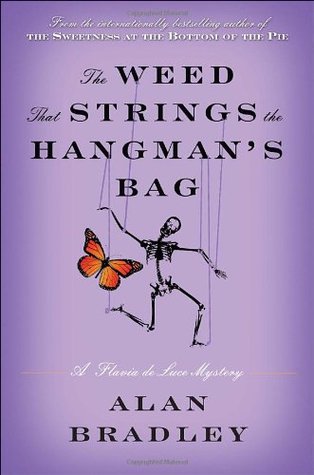
The Week That Strings the Hangman's Bag, Alan Bradley

Poor, Flave. Once again she's witness to a murder. At least this time she's not alone, though.

Charming and precocious Flavia deLuce is back in another murder mystery. This time, a puppeteer meets his untimely demise in front of half the town, in a production of Jack and the Beanstalk. Our favorite, pint-sized sleuth uses her strengths- wit, keen observation, and unquenchable curiosity- and her weaknesses to solve the puzzle.

It's an odd mystery that makes it almost halfway through before the murder occurs. A good bit of the character development of the less-than-angelic Mr. Porson takes place before he dies. Like preparing a good meal, Bradley seasons and salts the character after death.

Alas, the story itself is just not as good as the first. Usually I find that an author gets better within a series, but this is decidedly worse than The Sweetness at the Bottom of the Pie. As much as I looked forward to continuing the series, this one left me unimpressed. Flavia's connection to the story is weird and shallow. The mystery arc itself might have been good, but it doesn't relate to Flavia in even a suspension of disbelief-believable way.

Hangman only earns 2.5 Marias. Maybe I'll try another later.


Thursday, August 25, 2016

A Piece of Fanfiction


Where, oh, where do I begin? Since my thoughts on this book are so scattered, I'm going to try to put them down in an orderly, start-to-finish fashion. Let's hope I don't get sidetracked.

Ok, first. THIS BOOK IS NOT WRITTEN BY JOANNE NO-MIDDLE-NAME-BUT-THE- EDITORS-DIDN'T-THINK-BOYS-WOULD-READ-A-WOMAN'S-WRITING ROWLING. That's not entirely true. The people who wrote this lifted entire scenes from the real Harry Potter series, so that dialogue is consistent with the characters we know and love. The rest of the story- not even close. It's like they took the original stereotypes we had about them all, added 20 years, and never bothered to let them grow beyond Year One. Except Harry, who has turned into The Man, not the one you buy shots for- the one who keeps you down.

Back to that middle name thing- how in the world, did someone at a publisher, probably several someones, read The Philosopher's Stone, realize that it had great potential and not realize that it had Universal Appeal? I realize that boys are not encouraged to read about girls while girls are expected to read about boys and girls, but really? The first is filled with female characters that girls should get closer to- Macgonagall, Molly, HERMIONE. The whole idea that Rowling was forced to cloak her identity to protect poor little boys who might accidentally enjoy fiction by a woman just sets my feminism bone a-buzzin'.

Parts One and Two- this is not only unnecessary, it's false. I hate to be the Dwight Shrute here, but one could not read just Part One and have a complete story. They are dependent on each other to tell a whole story arc. There's a semicolon at the end of Part One, not a full stop. Also, none of the children are actually cursed, so the title is inconsistent with the rest of the stories.

Now into the actual pages. I cannot, for the life of me, figure out how this is a stage production. The scenes are so short and shift setting so often, you'd have to have the best set people in the world, possibly a rotating stage or a huge one. The huge one is probably how it happened because the characters don't move around while they are together or talking. So one huge background, lit the right, very focused way, could bounce around all over the magical world. I imagine it a very complicated production. In addition to the logistical nightmare, most of the scenes are so short there would have to be a lot of scrambling about on stage. One scene is a single page and doesn't contain a word of dialogue. And don't get me started on the actual magic that would have to occur. On stage. There's polyjuice, people.

The characters- what have they done to the characters we know? Macgonagall has lost her soft spot for Harry and the Gang. Headmistress must be a tough job if it crushes her spirit. Remember, she was a strict teacher, but she had a quiet, impish fire inside her. How did the woman who gave Harry his Nimbus 2000 come to merely tolerate him now that he's Head of Magical Law Enforcement? Was Ron lobotomized? Why doesn't Neville ever show up on stage? What has become of Teddy? WHERE IS HAGRID?

One of my favorite things to ponder is how the original stories would be different if Harry had accepted Draco's offer of friendship on the Hogwart's Express. Would Harry have become a Slytherin? (oh my goodness! it looks like this might be about that. Oh, wait, no.) What different path would he have taken to defeat Voldemort? Would the prophecy been about Neville instead? Would Ron and Hermione gotten together? Oh, the possibilities are endless! I got excited at the beginning of this book thinking that someone else had put pen to paper and drawn up one possible scenario, just one generation off. It starts with that premise a little bit- Albus is a Slytherin and friends with Scorpius, son of Draco- but that's about as far as that goes.

The story is unbelievable even when you suspend disbelief enough to accept magic. There are gaping holes. Is The Augury a bird, a child, or a place where they roast muggles? It is never referenced in the original novels, just in video games and later companion books. Now that Draco is out from under his father's thumb, why is he still a dickweed? Did he and Harry really not figure a way to be friendly in the twenty years since The Battle of Hogwarts? I could've sworn that a major theme of the series was redemption and forgiveness, I expect the hero to apply that to others, too. Why was Cedric's death so much more influential than any other person who died for The Cause? Did the writers fancy RPatz and wish him to not be sparkly?  And why hasn't Harry's scar been bothering him this whole time Voldemort's Child has been alive? Because it hurt him from the moment Moldy Voldy started sucking on unicorn blood in the first one. It wasn't that he was taking power and making efforts to destroy anyone, his mere existence was enough.

So despite all these complaints, I still liked the book. I was, once again, whisked away to a fantastic world where anything is possible, where good will triumph over evil, where people drink butterbeer. I think the writers, publishers, and producers were banking on that nostalgia to sell a truckload of books. We Potterheads will buy anything remotely related to Harry, Ron, and Hermione. We're still talking about the stories nine years after the last one was published. They are enchanting and magical themselves. After all these years? Always.

Being connected to the originals is enough to earn this one three Marias. I know many will argue I'm being sentimental, and I'm ok with that.


Tuesday, August 9, 2016

A Book That Makes No Sense


Orchids and Stone, Lisa Preston

I'm just making up categories now, so I figure I should try to make them entertaining. Unfortunately, entertaining is not how I would describe this book. It's pretty much the reason I cancelled my Kindle Unlimited membership. If this is the kind of drivel they are going to offer me for $10/month, I'd rather put that money towards stuff I can find at the used bookstore. Heck, I'll cut back on my Hardee's All Natural Low Carb intake and buy new releases to avoid crap like this if that's what it takes.

First, the title. Neither orchids nor stone play a vital role in the novel. Not only that, but they are never tied together. Of all the possibilities for titles (I suggest- Three Unrelated Stories, What's the Deal with Grandpa?, or maybe just What the F#$&), this one only makes sense because, like the different threads in the novel, they never connect enough to create one cohesive story.

The first thread is that this woman dropped out of college and became a roofer. She's pretty good at her job. Some dude on her first day wasn't thrilled that she could handle it. Spoiler alert- roofing is the only thing this woman seems capable of doing. She's a static character that never applies the life lessons thrown at her to actual life.

Then there's the thread of her murdered sister and her father's subsequent suicide. Talk about an anti-climactic resolution. Weak, weak, weak. I'll save you the trouble- the guy is dead.

There's also a thread about her relationship with her boyfriend and his two children. There are glimpses into the complications of blending families, but the children's behaviors go largely unexplained (and are somewhat inexplicable). Boyfriend's dad is also in a nursing home, which is probably supposed to help build tension but fails.

There's also the elderly woman in the park begging for help. Here's where the story really goes off the rails. It's kind of the main story except the narrator keeps coming back to these other, unrelated distractions. It's also ridiculously unrealistic. And the resolution to this conflict sucks just as bad as all the others. There is an attempt to link it to the murdered sister because Daphne (I finally looked it up for you) feels compelled to help the stranger and wishes someone would have done the same for her sister.

I think the biggest problem this book faces is trying to tackle too much with one book. There isn't enough to tie the different tales together (the only thing that does is Daphne, and I didn't really like her anyway). If Preston had focused on just one of the main themes- compassion/antipathy, surviving sibling of murder, family dynamics, workplace mysogyny- she could have come up with something readable with the right editor. Instead, we're stuck with a novel so bad that even the fact that it's "free" doesn't redeem it.

In short, don't waste your time. This book was a huge disappointment. One Maria.


Monday, August 8, 2016

Reading Aloud

I recently attended a webinar by Andrew Pudewa, founder of the Institute for Excellence in Writing, also known as "the funny man with the wonderful words." Mr. Pudewa is indeed a funny man who presents an engaging approach to teaching language arts at home and in the classroom. We are about to start our second year of IEW, but I'm not here to talk about homeschooling exactly.

The webinar was about how to develop a broad vocabulary in children, and one of the best ways to do this is to read aloud. Now, as a busy mom, I had kind of gotten to the point where reading aloud was losing priority because our oldest can read- he finished the Harry Potter series in a matter of days. Surely that is improving his vocabulary, right? Well, it turns out, just reading is not as magical as I would have thought. So, after about an hour with Mr. Pudewa (or just Pudewa as he is known around our house), I realized I needed to be reading aloud to all my children. And not just Go, Dog, Go for the zillionth time.

Next I was faced with the task of picking the best titles to read to three children, ranging from 3 to 8 years old, with a variety of interests. The oldest loves magical adventure stories, while the middle is easily frightened. The younger two don't flinch at death, while the oldest is compassionate. I wanted to include strong female characters, too. So from the bookshelf, I selected our first (even though we've done this before) Read Aloud:


The Lion, The Witch, and the Wardrobe, C. S. Lewis

Before I started reading, I explained to my daughter that this is one of my favorite childhood books. I told her that sometimes she reminds me of Lucy. I left out the part about pretending to be Lucy when I was a child, but it's true.

The story is not overly complicated. Four children stumble upon a magical kingdom where the White Witch has cast a spell that makes it always winter and never Christmas. The children meet talking animals and magical creatures on an adventure that lasts a lifetime or only a few seconds.

Girl-child is the only one who sat through the entire reading, but something I caught Oldest-boy standing in the hall listening in. Everyone followed the story well enough, even the 3-year-old. There were plenty of new words to absorb; I was occasionally stopped to define one. But overall, it was understood enough to make a story. There are, of course, subtleties in the writing (Spare Oom, for example) that the children will not appreciate until they read this one on their own. But we had fun reading it together- summarizing, making predictions, and imagining how we might find our way to Narnia.

As I mentioned before, this is one of my favorite childhood books, so it earns a permanent place on the bookshelf with (surprise) five Marias. But in addition to the rating, I want to encourage parents and teachers to read aloud, even to children who can read. It has made a subtle, positive impact on our days and is now one of the things I look forward to the most.

Monday, July 4, 2016

Chapter 41: A Book With Bad Reviews


The Sweetness at the Bottom of the Pie, Alan Bradley

This is just a silly category. Every book has someone out there saying they hated it. I mean, just scroll through some of my previous posts and you can see that. But I'm crossing it off the list today.

It's already well documented that I love a precocious, intelligent girl protagonist. To say that I'm charmed by Miss Flavia deLuce would be an understatement. A ten year old who says, "I might be considered a very dangerous person," and means it is simultaneously frightening and delightful.

Flave is the youngest of three sisters living at Buckshaw, a once-regal country estate that has passed its prime. She's fascinated by chemistry, especially poisons, and never wastes an opportunity to stick her nose into trouble. When she stumbles upon a dying man in the cucumber patch, her imagination and wit take her on an adventure of intrigue, danger, and stamps.

One of the frequent complaints of this book on Goodreads is that Flavia is unbelievable. Clearly these people do not remember what it's like to be a smart, 10-year old girl. These readers underestimate the abilities of the girl, much the same way the older sisters and constables do in the book.

The story itself is a typical whodunit. The reader makes connections quicker than the hero. The bad guy gets caught. The unlikely detective gets a token of gratitude or praise. Somehow, told through Flavia's eye, even a mystery about stamps (stamps! sorry, philatelists, but you've got to expect them to seem boring outside collector circles) is engaging, funny, and interesting.

Sweetness earns 4 Marias. I plan to read more of the series just too find out what Flavia is up to next.


Monday, May 9, 2016

Chapter 40: A Play

A Midsummer Night's Dream, William Shakespeare
No Fear Shakespeare Edition


I have never used Cliff Notes, Spark Notes, etc. Ever. Because when I was in school, they were seen as an excuse to know enough to pass a test without reading a book instead of as a study guide. But this was the only version of MSND that was available at my library, so I checked it out.

We've been doing this thing in our homeschool where we spend some time in the mornings doing something with the arts. We've memorized Jabberwocky and watched OK Go videos. Soon we will begin reading some Shakespeare. Before I try to teach my kids something, I probably should have a grasp for it. So this kills two birds with one stone.

I'm not going to go much into the actual play. It's Shakespeare. He's great. It's great. Blah, blah, blah. But I would like to talk about this side-by-side edition. I think it's a great way to make complicated language accessible to more people. I still read the original text, but it was easy to find a modern translation if I was unsure of my own. For the most part, I got it. But there were times that a minor change affected the story. Now, I'm not going to pretend that I caught all the subtleties of the Bard's writing- far from it. But having the translation *right there* gave me more confidence as I read the lines. It took a lot of the intimidation out- which is just awesome. If I worry and struggle- and we all know how much I love to read- then imagine someone who doesn't. Imagine a student whose family speaks another language at home. Imagine a person who thinks very logically and has difficulty understanding flowery or figurative language. This little book could make a world of difference for them. How cool is that?!?

When I was in high school, I had an English teacher who loved to teach Shakespeare. She was a very prim and proper woman, one might even accuse her of being dour. But she got a sparkle in her eye when talking about ol' Bill. She led a field trip to Canada every year so students could see multiple plays in a weekend. She had a gift for making Shakespeare relatable to many teenagers, including explaining the dirty jokes. This edition was like having Mrs. Burns reading beside me and telling me the secrets. I like to think she would approve of a study guide.

I'm not really sure how to rate this one. It's a different kind of review. I'll definitely use this series of guides to help my kids and myself with literature, but I wouldn't just recommend it to anyone looking for something to read. I'll leave Maria out of this one lest I sound like an advertisement.

Saturday, April 23, 2016

Chapter 39: A Book with a Color in the Title


Island of the Blue Dolphins, Scott O'Dell

I'm surprised I never read this one. I like historical fiction, and Island definitely belongs on several lists of books popular with tween girls, but maybe I was just too busy with Louisa May Alcott and the Babysitters Club series. Anyway, I picked it up for the Blue, not really knowing anything about it.

O'Dell took the true story of a woman who lived alone on an island for 18 years and turned it into an award-winning classic. Unlike other historical fiction I have enjoyed, like Phillipa Gregory's Tudor series, there is actually very little of The Lost Woman of San Nicolas that can be verified. Even the author's epilogue is disputed by some history buffs. So, with accounts given through pantomime and signing and the logs of a couple of captains, O'Dell crafted the tale of a woman's loneliness and survival. Regardless of how accurate it is, it belongs on children's shelves.

I'm not going to get into details of the plot, but I never thought details of fishing for a squid could be so compelling. Her relationship with the animals of the island makes me surprised Rontu isn't a more popular dog name.

There's no telling what "Karana" actually encountered and endured all those years, but I think O'Dell did a nice job of creating some conflict and resolution without turning it into an exhausting array of near-death experiences (something I grow weary of when reading the Outlander series). Karana is a realistic badass that I look forward to introducing my kids to. She earns 4 Marias for Island (and here is where we make a remark about white men getting things that natives/women worked for).

Saturday, April 16, 2016

Chapter 38: A Book with a One Word Title


Baggage, S.G. Redling

Another Kindle Unlimited title that I snagged to cross off an item on the list. I did not have high hopes for this book. The first 30-40% of it, I was sure the whole thing was going to be awful. Besides the single word title, I picked it because it reminded me of slam dancing with my sister at The Metro to this. So, I was surprised when the story (finally) caught my interest.

Anna Shuler Ray has had terrible things happen to people around her on February 17. Really, really terrible things. To two people, so it seems more like a coincidence than some sort of lifelong pattern. So while she is drinking herself into a stupor in an admittedly poor attempt to cope with the anniversary, someone on her campus is murdered. In the building where she works. Oh, and the guy is interested in her.

Cousin Jeannie is in town, as some sort of enabling support. I mean, sure, sometimes cranking up your favorite childhood pop hits, devouring junk food, and chugging bottles of wine SEEMS like a great idea. But, really? Is this helping someone you love? Someone you consider your sister? This falls firmly on my list of Bad Ideas.

So, ambitionless alcoholic narrator is similar to Girl on the Train, but unlike Rachel, Anna has zero interest in getting involved in another crime. She tries so hard to avoid any connection that she draws attention to herself. As the story progresses, the story arc I expected to unfold doesn't. Well, not exactly. I was right about the villain and the motive, but how we get to that point was not what I thought.

Even with a rough start, Anna's tale became more engrossing. The flashback chapters were clear and crucial to understanding how Anna has become some miserable. I found myself liking her more, in part because the third person flashbacks give her some tenderness and vulnerability that the first person narrative full of self-deprecating remarks dragged the beginning. By about halfway through, I wanted to read more- not so much for the revelation of The Big Secret, which was no surprise- but to see what kind of road Anna might move along next.

One of my favorite scenes is in the police station, when an officer has confronted Anna with a particularly painful piece of evidence that ties her to the campus murder(s). The rest of Anna's lines are simply "fuck you." Over and over. And it was great because I felt that complete loss of any reasonable response and her need to just stand her ground with her "phrase du jour." It was comedic, dramatic, and realistic. I loved it.

My biggest disappointment with the novel is that there is mention of a crime from the past that earned a name. You know the type- BTK, Westside Strangler, Columbine. Sensational murders that could be concentrated into a few little words that are universally recognized for their horror. So, after reading the book, I googled the name of the crime from Anna's past. No wikipedia entry. Nothing. And I just feel like making a couple of true crime-style webpages would be a great publicity for the book and just add an element to the overall style. I know this is a fictional crime, but having that to read after would have probably earned an extra half Maria.

Still, I enjoyed the book once it really got rolling and found myself interested in a pretty flat character. So Baggage earns 3.5 Marias for being surprisingly satisfying.

Sunday, April 3, 2016

Chapter 37: A Book Set in the Future

The Giver, Lois Lowry

Newberry winner, turned into a movie, people name their child after one of the characters- maybe my expectations were high for this one. After that insomnia-destroying violin book, I thought this might be a tense enough story to keep me awake. Mostly it did, but was it worth it?

First, let me state for the record that Child #3 did not get his middle name because of this story. I won't ever pretend at some point in the future that it had any influence on the choice. But when I read the author's introduction in which she claims many fans have sent her letters saying they have named their child for one in the novel, well, I expected something original, thought-provoking, and amazing. What I got was ... meh.

The premise of the story has potential- after generations, a community has achieved sameness. Sameness is probably not even the right word, though. People have different abilities and interests, but almost every person has the same life-trajectory. Born > placed with a family unit until adulthood > productive member of society > retirement to the home for old persons > release. Anything other than that is an anomaly and people avoid discussing it because being polite is really, really important. Sounds like things could get pretty interesting, right? You'd think.

Enter Jonas. At Level 12, he gets skipped over in the ceremony that announces what his future job will be. After his peer group gets their assignments, Jonas is called to the center of the room and told he has been chosen for a high honor. He will be Receiver of Memory. His training begins the next day and we are assured it will be painful. Ok, let's see where this is going.

Oh, nevermind. There's snow and a sled and the Civil War and then boom! it's been a year and Jonas is almost done with his training. One of the special things he can do, that no one else can do because it isn't polite, is ask prying questions. Jonas learns what release really involves (I won't spoil it, but it's no surprise. At all.) and decides to run away with the collective memories from generations past. And he takes a baby with him.

Ah! So the journey is going to be a big part of the plot! We're going to see Jonas and Gabriel bond and experience new things now? Nope. It's going to take a single chapter to get through what is a very long journey (I assume). And that's the end. No revolution. No conflict wherein the Elders try to change Jonas' mind. No word at all of what becomes of the Community members Jonas once cared for- his parents, sister, and friends. Just ... The End.

I just can't believe with this much material, this is all we get. And that people love it so much. It's not terrible. It's written well enough. It just lacks so much- character development, continuity, conflict. I guess I could be generous and call it a Revolution of One, but without more information I can't even do that. This story is like a Slim Fast shake instead of one of those insane buffets in Vegas. Overall, I'm underwhelmed. I won't read it again or expect my kids to (but they can if they want). The Giver gets a disappointing 2.5 Marias.