Showing posts with label based (loosely) on a true story. Show all posts

Sunday, March 12, 2017

Dreamland Burning


Dreamland Burning, Jennifer Latham

Brace yourselves for a bit of a rant that isn't directly about this novel and yet is. It's a re-hashing of my thoughts on The Help, so if you are tired of that one, feel free to skip this entry.

The concept of this novel is good. It has so much potential- two mixed race teens separated by decades, united by a corpse. There's a hint of mystery, some interesting historical detail, and a whole lot of trying too hard.

I'll start with the heavy-handedness of the social issues that create the tension of the stories. Considering that the central events revolve around a race-line conflict that left the black areas of Tulsa in ashes, we don't need to be hit over the head with "racism is bad, mkay?" And the supporting character, the girls best friend who also happens to be an asexual guy, is the weakest conjured sidekick I can imagine. He's got a cool car and he's asexual. He's asexual. Oh, by the way, he's asexual. He's also black- which would be much more pertinent to the main story- but we'll keep focusing on his sexual identity, regardless of how little it progresses the story. There are no situations where it's relevant, except to really make the point that their friendship is truly platonic. So it comes across as a detail that was just thrown in to make the whole novel more diverse. Same with the other teen's native mother, although her background gives a little bit of structure and context. We also get a homeless man and an addict as secondary or even tertiary (man, I love that word!) characters to round out our coat of many colors. And this, my friends, is also where I get my knickers in a knot.

This book is written by a white woman. Now, don't get me wrong, I love intersectional feminism and want WW to be good allies. Every important character in this novel is a Person of Color. All of them. Then why is Nice White Lady the one telling it? What insight could she possibly have into the everyday lives of mixed-race Tulsans that we couldn't get from, I dunno, actual POCs? Maybe, just maybe, this isn't her story to tell. Maybe, she could've told it from a different perspective that she can actually relate to better, and, therefore, made it more believable.

Elvis didn't invent rock n' roll.
Aibileen should've written the book, not Skeeter.
Miley wasn't the first to twerk.
The list goes on.

Now, without trying to sound like a hipster, I want authenticity in a storyteller. That doesn't mean that no white person can ever write a character of color, no straight person can ever write a queer one, no man can ever write a woman. But for the love of Benji, can we please, as white people who like to write, please take a step back? Can we please not assume we can tell these stories better than the people who have actually lived them? And, if we insist on still telling them, can we please do some actual first-person research? Maybe not try to frame an entire novel as a way to fix the social injustices that we are actually largely (if not totally) responsible for? I mean, can you imagine if Jodi Picoult tried to write Push? That's pretty much how this one reads.

And, let's be honest, the two main characters are heroes for different reasons. The young man, who passes as white but is called half-breed by the utterly one dimensional bad guy, who is not in touch with any of his native ancestry, swoops in during a tragedy to rescue a couple of black people that he happened to actually talk to. Thank you, White Savior. We're all so super grateful that you went from punching a guy and getting him worse-than-lynched to carrying beaten black men to a sanctuary. Really, it's great that this guy had a change of heart and did some pretty brave acts on that one single night, but ... then he gets to vanish. He's done his part. Give him a cookie. The young woman, who benefits from her white daddy's public standing, lives in her ivory tower, and is so far removed from not only her black ancestry but also even middle class life, gets to pin a rose on her own nose because she finally has empathy for a homeless man after he dies. I get it. They're kids. They haven't experienced the world outside of Tulsa. It's just so ridiculous that both of them have these massive changes of perspective seemingly overnight. It's so insincere and they have hidden in their privilege for so long I find them hard to like.

I could probably ramble on for several more semi-coherent paragraphs, but I won't. This story is weak and ambitious. It's not particularly well written. It's not challenging or engaging. I did read the whole thing, so it's better than The Orchardist. It gets credit for giving me something new to research- the Tulsa race riot. Dreamland Burning gets a lowly one and half Marias.

P.S. I'm trying to consume more works by outsiders. If you have a recommendation, drop a comment, please.

Sunday, October 9, 2016

Room

Room, Emma Donoghue

I started this one, put it down, came back to it. The concept is fascinating and I really wanted to love it. But I had to get through the first section before I could.

In an interview at the back of the book, Donoghue says that people will love the first part or the last part. Boy, she wasn't kidding! I liked the story of the first part- while Jack and Ma are still in captivity- but the storytelling made me want to do violent things to my copy (which, I promise I would never do).

The whole book is told by Jack, a five-year-old boy born and raised in a single room. His mother was kidnapped at 19. All he knows is Room. He gives titles to the objects in his room, much like the language of A. A. Milne's Winnie the Pooh series. And I love that! I have written a few essays about "proper verbs" and how this incorrect grammar actually represents ideas about language that children have but don't have words for. So that part was good and gave me hope for the rest of it. But it soon became difficult to believe Jack.

Given the headlines about children born in captivity- Jaycee Dugard (who was found after Room was written) or Elisabeth Fritzl- Jack's perspective is sadly believable. But what he knows and doesn't know is so unbelievable that I hated the first half of the book. He watches tv and listens to the radio, but doesn't know there is anything outside of Room. He watches cooking shows, but says Ma "hottens" food. At age five, he knows how to read and multiply but says if he touches the stove the red would spread to his clothes- even though he knows the word fire. It's this bizarre inconsistency that made the first half difficult to get into.

Then the break comes. Ma, who remembers Outside but has spent five years teaching Jack that there is only Room, wants out. She has to undo all the lies she has told and put her baby in the most extreme danger. Here's where it gets better.

After a milder escape and rescue than one might imagine, Ma and Jack move out of Room and into a psychiatric clinic. Ma is relieved to be out of captivity; Jack wants to return to the only world he's ever known. Together, they have to navigate a new life. The second half if painful and joyful, endearing and heart-wrenching. And makes the whole novel readable.

I don't know how they are making a movie with so much exposition from a five-year-old, but I hope the film version manages to be as realistic as the book and doesn't sensationalize an already outrageous story.

Room gets off to a rough start, but earns 3 Marias overall.


Saturday, April 23, 2016

Chapter 39: A Book with a Color in the Title


Island of the Blue Dolphins, Scott O'Dell

I'm surprised I never read this one. I like historical fiction, and Island definitely belongs on several lists of books popular with tween girls, but maybe I was just too busy with Louisa May Alcott and the Babysitters Club series. Anyway, I picked it up for the Blue, not really knowing anything about it.

O'Dell took the true story of a woman who lived alone on an island for 18 years and turned it into an award-winning classic. Unlike other historical fiction I have enjoyed, like Phillipa Gregory's Tudor series, there is actually very little of The Lost Woman of San Nicolas that can be verified. Even the author's epilogue is disputed by some history buffs. So, with accounts given through pantomime and signing and the logs of a couple of captains, O'Dell crafted the tale of a woman's loneliness and survival. Regardless of how accurate it is, it belongs on children's shelves.

I'm not going to get into details of the plot, but I never thought details of fishing for a squid could be so compelling. Her relationship with the animals of the island makes me surprised Rontu isn't a more popular dog name.

There's no telling what "Karana" actually encountered and endured all those years, but I think O'Dell did a nice job of creating some conflict and resolution without turning it into an exhausting array of near-death experiences (something I grow weary of when reading the Outlander series). Karana is a realistic badass that I look forward to introducing my kids to. She earns 4 Marias for Island (and here is where we make a remark about white men getting things that natives/women worked for).

Saturday, August 15, 2015

Chapter 25: A Pulitzer Prize Winner


To Kill a Mockingbird, Harper Lee

Are you shocked? Floored? Flummoxed? Bamboozled? I didn't think so. There's no way I could read Watchman and not re-re-re-re-read Mockingbird. And, as I also re-watch Pretty Little Liars now that the show has revealed who A is, I realize the Liars are reading Mockingbird for English class. So Liars gets a little more credit from me (the mental hospital is named Radley, too, but I had not forgotten that fact).

So, Mockingbird is required reading in high schools across the country, with good reason. It opens the door for Humanities teachers to discuss racial history in the U.S., introduces students to an influential female writer, and gives an accessible account of southern life during the Depression. All of that is great, but it's not why I love this story. When it comes down to it, I love Scout. She's precocious, obnoxious, naive, and wise. She's brash, unruly, unladylike, and charming. She is, in short, a little girl.

Now that Mockingbird is fresh in my memory, the conflict of Watchman is actually pretty predictable and is totally fitting with the characters. We love the Atticus of Mockingbird for many of the same reasons we (the readers and Jean Louise) feel betrayed by him three decades later. It's funny how much the era of the story affects how we feel about the exact same behaviors. In the 30's, he was a leader, a champion, worthy of our adoration. In the 60's the same kind of ideas land him firmly in inexcusable territory. This, of course, is indicative of how fast things changed in this country during those decades, but also how we are willing to overlook things we don't like (paternalism, pity) if our hero does something great (defending a black man against accusations made by whites). This idea still holds true today. How much bad are we willing to ignore if the overall result is good? What is the tipping point at which we change our opinion of a person or organization?

While I think this is all important stuff to think about and discuss and question, it's not the root of why I love this book so much. In fact, it's peripheral to the heart of the novel, in part because a nine-year-old doesn't really grasp the implications of the case her father is working. Scout just takes the world at face value. She believes what her important adults (Atticus, Calpurnia, and Miss Maudie) tell her and suspects everyone else of falsehood. She is quick to defend those whom she loves and has a strong sense of fair, even if it is flawed. Her father has taught her important truths she won't learn anywhere else, namely that all people, even those we deem beneath us, have dignity and deserve if not our respect, then their privacy. It seems to me that this is a dangerous lesson, minding your own business to the detriment of your fellow humans. He starts out with a grand idea but let's it fizzle out in the details.

Scout, however, just applies her lessons to everything. She doesn't see the subtleties of the class divisions in her community because she believes that people are people. She knows they exist, that certain families just have their ways, but she is pragmatic and doesn't judge those other ways. This lovable little tomboy teaches (and learns) more about community than many give her credit for. Often readers feel like they are with her in Atticus' lap, that they learn alongside her. But in my estimation, Scout Finch is the true hero of the tale.

Even though it is set in the 1930's, Mockingbird still is relevant today. One paragraph stood out to me, speaking volumes about how quickly and easily we dehumanize each other. After confronting a group of men who set out to harm the black man accused of raping a white woman, Atticus tells his son, "A mob's always made up of people, no matter what ... a gang of wild animals can be stopped, simply because they're still human. Hmp, maybe we need a police force of children ..." Our failure to see others as humans is easy and enormous. Instead of images of five Marias, I'll leave you with these three images of humanity during conflict. (And, I'd like to just say that it is crazy to me that Sen. Pugh was criticized for hugging a rioter. What she did was not condoning actions but saying, "I see you, I hear you, I acknowledge that you are a person.")


Wednesday, July 22, 2015

Chapter 22: A Book Published This Year


Go Set A Watchman, Harper Lee

You can't possibly be surprised that the most anticipated novel of the year is my selection for this category. Normally I try to keep my posts to the actual book, but there is no way to discuss this one without including a number of other issues. I'll try my best not to give away the plot beyond what is necessary.

First, the legal controversy. I was wary of purchasing Watchman because of the allegations of elder abuse. So I turned to facebook, specifically friends who I trust in important matters of southern writing, and not only agreed that the evidence of abuse was lacking but that Ms. Lee had a much more personal reason for holding back on this particular piece. The real Scout still has that compassion she learned in Atticus' lap decades ago.

Next, the writing. Watchman was rightfully rejected by Lee's publisher not because the story is bad but because it is immature. Understanding and loving Scout and Atticus of To Kill A Mockingbird makes Watchman a very different novel indeed. And, if you are like me, you grew up loving Scout like a sister. Atticus was the kindly neighbor who taught the whole community with his placid ways. But Jean Louise, as an adult, has a lot of growing up still to do. Without fully knowing her upbringing, she would come across as hysterical and dramatic- not that the situation doesn't warrant some histrionics, but the context of her childhood makes her wild reaction more sympathetic.

Now it would be unjust to discuss this novel without also talking about race and racism in America. I can be clumsy in these talks, so please have mercy and bear with me. Though set in the 1950's, the book could still be set today. In the wake of many headline-making stories of racism, "look how far we've come" seems to be not very far. Maybe we are not talking in productive ways. Is it possible for a person to be good and also be racist? Can a white, especially a southern white, speak against racism without being paternalistic? (This is one of those areas where I get very clumsy because, surprise! I don't know what it's like to be black in America. I know stories. I know what I witness, but that is not the same. Whenever a major event occurs and we as a nation talk about race in some new context, I  defer to someone with experience that I cannot possibly have. Sometimes that makes me really uncomfortable because I am faced with my own prejudice, but I am a seeker of knowledge. /tangent) Is it possible for a kinder, gentler style racist to move beyond that? Or is the psychic pain just too much to bear?

Some other things that this book has me thinking about- the tangled relationship between law and social change. Am I a Scout? Or am I an Atticus? Do the ends justify the means? Whose responsibility is it to help adults grow? Is there such thing as collective consciousness? I don't know the answer to any of these questions. I have ideas and I have a willingness to listen to other people's ideas on the subject, too.

So, aside from the racism, Lee really hits on some other things that I think have been overlooked by many because they are small in comparison. But I feel like she did a wonderful job of capturing what is now called the quarter-life crisis. Jean Louise has graduated college, is living on her own far from her home and just now really having to define herself as an individual. I'll be honest, I was so glad to get out of my 20's! There was so much turmoil and drama. I understand Jean Louise's wild reactions because I felt so passionately, too. But time has mellowed me some and maybe it will her. It does make me wonder if Atticus was ever so fiery, but we will probably never know.

The other thing illustrated beautifully in Watchman that lives in the shadow of Atticus' fall from grace is related to that fall and to Jean Louise's age. Scout left home. She returns annually as if it is a duty. She detests much of Maycomb, yet loves it, too. In all of her struggle, she fails to see how very much like her father she is, even when she thinks she hates him. The old adage "There's something about that guy I just don't like about myself" is spot on in this case. I'm not sure if Jean Louise ever comes to that conclusion. Honestly, I'm not sure what becomes of her. But the glimpse into her life as a young adult was interesting and thought-provoking.

Go Set A Watchman earns three and a half Maria's. It's not the best written work. On its own, it isn't even that compelling a story. But the context- that changes everything. For me, it's more an epilogue of Mockingbird than its own tale. I'd like to note that even if it isn't the best book published this year, it still belongs on the shelf with important literature. It still should be read. It is still relevant 60 years later. And, perhaps, as we undergo yet another Reconstruction (and future ones, too), we can learn something from Maycomb.

Tuesday, May 12, 2015

Chapter 16: A Book That Made You Cry


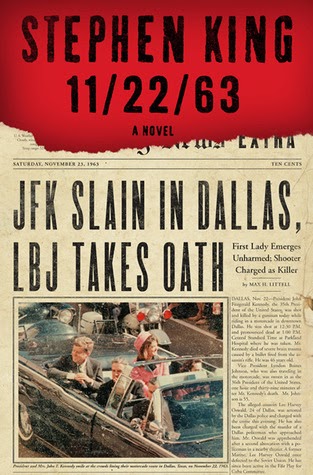
11/22/63, Stephen King

So much to say about this book. First, I don't think I've ever read anything by Mr. King. I remember a classmate in high school who read him almost constantly. He would carry one enormous volume after another on top of his textbooks and read them in stolen moments between classes. The sheer number of pages made me seriously question how he did anything else. Maybe that's why he was so thin. Anyway, John S. never convinced me to pick up a King novel, but my best friend and voracious reader, Elizabeth, did. She's never let me down in the entertainment category, so I checked this one out expected to cross A Book Your Best Friend Recommends off my list. As is becoming a theme here, it wasn't what I expected, and I had to shift from my original plan.

To be totally honest, I didn't actually shed a tear. But a few pricked up in my eyes, and that's about as close as it is going to get for me. I expected I would have to find a truly hilarious book that would make me laugh 'til I cried to accomplish this one. Instead, the man who brought me Carrie (one of my favorite movies of all time), nearly brought me to tears. He deserves credit for that.

Now, in order to get to the tears, we have to go back to what I thought the book was about. Even after reading the cover, I thought it was going to be about saving JFK from assassination. I thought it was going to be about an obsessed time-traveler. I thought it was going to be like one of many conversations I had in middle school with my friend, Stacey, who was so fascinated by the entire modern Camelot legend that she did an incredible re-enactment of Jackie's reaction in the convertible. I can't think of Jack and Jackie without also thinking of her. I was expecting Dealey Plaza to be the center of focus and action. I couldn't imagine why it would take eight hundred forty-some pages to tell the tale. And in walks the legendary Mr. Stephen King.

Having never read his works, I was unaware of his ability to drift on about mundane, daily life and still have it be meaningful. The impetus for Jake-turned-George's travel through the bubble of time may have been to save Kennedy, but his specific method requires him to always start on a fall day in 1958, in Maine. He has years to plot and tweak before he must end Lee Harvey Oswald. Most of the novel is about the man George becomes during this time. He's an English teacher, not a history buff, so he doesn't act as a pre-vigilante, saving the world from numerous disasters. No, after a couple of local "corrections," he lives a quiet life in a small town and falls in love with Sadie.

Sadie is the new librarian. George is a new teacher. They have troubles like any couple. They dance. They help students in life-changing ways, as teachers are apt to do (is someone chopping onions?). They share their biggest secrets and suffer tragedy (must be dusty in here). They love fully and boundlessly, and that is what made me almost weepy. Who knew the Master of Horror could pen a compelling, utterly romantic story?

There are a couple of graphic and gory scenes, but nothing like what I expected. This book took me by surprise in so many ways. I don't have a copy now, but I might keep an eye out for it at used book stores. I imagine I would enjoy it again and maybe pick up on strings I missed the first time. Even though it set me farther back on my schedule, it was worth every word. 11/22/63 earns 4 1/2 Marias.


Monday, April 13, 2015

Chapter 12: A Book That Became A Movie


The Book Thief, Markus Zusak

I want to like this book. Really. It's got drama and books, the pages are filled with the complexities of human existence. But ... meh.

*** A VERY IMPORTANT NOTE ***
I'm about to tell you something very important. And I will use a wort, or word.
This gimmick is old. Boring. Redundant. Annoying. It makes me want to punch Death in the grapes.
I have to give Zusak credit for taking on a much-visited topic, Germany during World War II, from a less-used position, that of Death. And the core story arc would be compelling if it were readable. But instead we have a stuttering telling of a young girl in a poor home in Germany. She meets people. She cares for people. She helps hide a Jew in the basement. Everyone calls each other asshole. Everyone has nightmares. Everyone dies.

I'm going to attempt to discuss a few key points in an orderly manner, but having had my brain scrambled by this book, I beg your pardon if it comes out jumbled.

First, Death as narrator. This isn't a completely novel approach to storytelling (see what I did there?). At first I actually enjoyed reading the buildup of Nazi Germany from a non-human point of view. But, ugh, the gimmick. The flow is disrupted by those stupid boldface interjections of no value. And for a mostly indifferent persona, death sure uses a lot of indicators of extreme emotion. But to what end? To tell us what he's about to tell us.

Second, the book thief. Ok, let's start with the fact that she only technically steals one book in the whole story. One she picks up after someone drops it. Another she rescues from a pile of smoldering ashes. And, after she steals the one book, the owner starts leaving more for her to "steal." So, she doesn't seem very worthy of this title. And as the story progresses, you learn that Death, too, has picked up a book someone left behind. So he's a book thief too! Oh how clever! Not.

Then, the characters are not well developed. Hans has silver eyes. Rosa is a wardrobe of a woman with a cardboard face (whatever the heck that means). Liesel loves papa. Rudy loves Liesel. Max is a Jew. They are flat and they do incredibly foolish things. I think some of these instances, like giving bread to Jews as they are marched to Dachau, are supposed to illustrate the humanity of the main characters, that they really do love and care and pity the victims of the Holocaust. Except that giving them bread is sure to bring more suffering to the people- beatings or worse. So it seems, to me, that these are essentially selfish acts to alleviate some guilt of not acting sooner. It's certainly no black-and-white dilemma, but Death sure thinks it is. Over and over, acts of love bring more misery and death to the objects of that love. Death is kind of an asshole.

The tempo and chronology was the most troublesome for me. There isn't so much a foreshadowing of events as there is a sentence or two telling you something is going to happen. Then Death backs up (sometimes months) and finally brings you back to the original sentence. Again, it's gimmicky and tiresome. After everyone died, I kept reading and they were alive again. It took a big mental shift to figure out where in time I was. And then I leapt forward again. And literally the entire book is like this because the first sentence is that everyone dies. But the story doesn't end there. Oh no! We have to revisit the deaths a few times before Death finally wraps the whole thing up.

My big question about this novel is- what makes it Young Adult? Yes, Liesel is eight years old when it begins, but that doesn't seem quite enough. Teens these days are unlikely to even know a person who remembers WWII, so the specific story doesn't seem all that relatable. The major tensions of the book are not ones that exist in everyday life, at least not in the same way that other YA books I've read do. Maybe it's just another way to keep the realities of WWII Germany in current conversations. If so, it seems to be doing that. My teenage niece loves this book. I doubt she saw Schindler's List or Life Is Beautiful.

Overall, I'm pretty ambivalent about this novel. It didn't give me a case of the Feels. It wasn't new territory or groundbreaking insight. Nor was it really entertaining. But the context for the target audience and for effort alone, I give The Book Thief 2 Marias.