Showing posts with label more than 500 pages. Show all posts

Friday, February 17, 2017

The Fiery Cross, Outlander book 5


The Fiery Cross, Diana Gabaldon

It didn't take me quite this long to read book 5, but sometimes it felt like forever. Still, I've found a moment to write about this one.

If you don't know about Outlander, it's hard to describe. It is a mix of historical fiction, war, romance, fantasy/sci-fi, and ladyporn. Each novel is really long. There is a LOT going on in this story, and Gabaldon does a fine job of weaving a very intricate tale.

Back when I read A Book That Scares Me, I mentioned an incident with my friend. I'd been reading the first three installments of the Outlander series and I told her that, frankly, I was tired of all the rape. So I was going to take a break and pick up a new series. Unfortunately, it was the Girl With the Dragon Tattoo series, so *spoiler alert* more rape.

Well, when I came back to book 5, really the books are good but you can't just plow through the whole series, I told the same friend that I was starting it. I said something about how the title sounded like something about the Klan not clans (in fact there is a book about the history of the KKK with the same title) but wasn't. Well ... there aren't any white sheets involved, but it does lay the historical groundwork for what would become the white supremacy group we all love to hate.

The story- how many ways can colonists barely escape death? That could be the subtitle of this one. Fortunately for pre-Revolutionary mountaineers, Claire has brought her modern medical expertise back and is brewing some form of penicillin, making luxurious soap, and birthin' babies all over the Carolinas. At least no one kills a bear with a knife in this one.

I don't want to give it all away, but just as I was about to shelf Cross and turn to something else, BOOM! She tries to kill one of the main characters! You know when Jamie and Claire are going to die (or do we?), but there are children and grandchildren and tenants that are still a mystery. And let me say, it isn't an accidental misfire. Dude is hung as a prisoner of war. Well, that got my attention and I dove right back in.

This is not the kind of series where you can pick up any. You need to start at the beginning (a very good place to start). If you're like me, you'll start googling historical events you never learned in school, like the Jacobite rebellion. And, honestly, one thing I enjoy about the series now that they are in the Carolinas is that I'm familiar with the places and the names. If that's your thing, too, then keep at the series. If not, I can probably summarize seven bazillion pages for you over a cup of coffee.

The Fiery Cross runs along my other Outlander recommendations of four Marias.


Tuesday, May 12, 2015

Chapter 16: A Book That Made You Cry


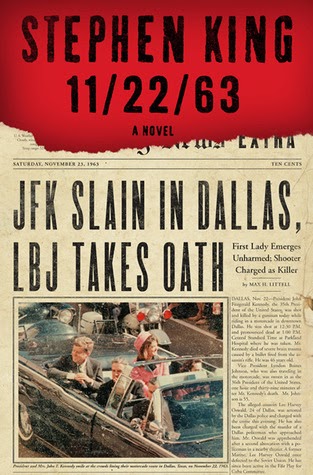
11/22/63, Stephen King

So much to say about this book. First, I don't think I've ever read anything by Mr. King. I remember a classmate in high school who read him almost constantly. He would carry one enormous volume after another on top of his textbooks and read them in stolen moments between classes. The sheer number of pages made me seriously question how he did anything else. Maybe that's why he was so thin. Anyway, John S. never convinced me to pick up a King novel, but my best friend and voracious reader, Elizabeth, did. She's never let me down in the entertainment category, so I checked this one out expected to cross A Book Your Best Friend Recommends off my list. As is becoming a theme here, it wasn't what I expected, and I had to shift from my original plan.

To be totally honest, I didn't actually shed a tear. But a few pricked up in my eyes, and that's about as close as it is going to get for me. I expected I would have to find a truly hilarious book that would make me laugh 'til I cried to accomplish this one. Instead, the man who brought me Carrie (one of my favorite movies of all time), nearly brought me to tears. He deserves credit for that.

Now, in order to get to the tears, we have to go back to what I thought the book was about. Even after reading the cover, I thought it was going to be about saving JFK from assassination. I thought it was going to be about an obsessed time-traveler. I thought it was going to be like one of many conversations I had in middle school with my friend, Stacey, who was so fascinated by the entire modern Camelot legend that she did an incredible re-enactment of Jackie's reaction in the convertible. I can't think of Jack and Jackie without also thinking of her. I was expecting Dealey Plaza to be the center of focus and action. I couldn't imagine why it would take eight hundred forty-some pages to tell the tale. And in walks the legendary Mr. Stephen King.

Having never read his works, I was unaware of his ability to drift on about mundane, daily life and still have it be meaningful. The impetus for Jake-turned-George's travel through the bubble of time may have been to save Kennedy, but his specific method requires him to always start on a fall day in 1958, in Maine. He has years to plot and tweak before he must end Lee Harvey Oswald. Most of the novel is about the man George becomes during this time. He's an English teacher, not a history buff, so he doesn't act as a pre-vigilante, saving the world from numerous disasters. No, after a couple of local "corrections," he lives a quiet life in a small town and falls in love with Sadie.

Sadie is the new librarian. George is a new teacher. They have troubles like any couple. They dance. They help students in life-changing ways, as teachers are apt to do (is someone chopping onions?). They share their biggest secrets and suffer tragedy (must be dusty in here). They love fully and boundlessly, and that is what made me almost weepy. Who knew the Master of Horror could pen a compelling, utterly romantic story?

There are a couple of graphic and gory scenes, but nothing like what I expected. This book took me by surprise in so many ways. I don't have a copy now, but I might keep an eye out for it at used book stores. I imagine I would enjoy it again and maybe pick up on strings I missed the first time. Even though it set me farther back on my schedule, it was worth every word. 11/22/63 earns 4 1/2 Marias.


Monday, January 19, 2015

Chapter 4: A Book With More Than 500 Pages

The Goldfinch, Donna Tartt

Before I even begin discussing this book, let me tell you how this happened.  See, one of the trickeries of this challenge is that some books fall into multiple categories.* And some of them may not even exist. So, I originally selected this title to check off Pulitzer Prize-winner. The problem with checking out ebooks from the library is that you might not pay attention to the length and end up with a 700+ page novel. Enter, The Goldfinch.

Remember the Seinfeld episode where Elaine talks about how The New Yorker comics are actually not funny, but no one will admit it because they don't want to sound dumb? That's how I felt reading this book. Among other things, Tartt relies heavily on place names around New York City, which mean nothing to someone who has never been. There is also much talk about art history and appreciation that go beyond an average reader's grasp. More importantly, the details are not important to the story and could easily be edited down. Too many pages are wasted saying, "Look how learned I am!"

Ok, that's annoying enough. But what about the story? Well, it's okay. Pretty much everyone dies. The main character, Theo, should be sympathetic since his beloved mother dies early on and he survives the terrorist bomb that kills her. But he's not. He's surrounded by deeply flawed people who put way too much effort into helping him and he does not appreciate it. Still, the arc of the story is interesting and has several twists, but it could be whittled down by a few hundred pages.

For as many pages as Tartt splatters with depictions of drug-induced teenage antics (how many ways can you describe lights?) and benign, insignificant details of daily life, she then skips over 8 years completely. Theo runs away from Las Vegas as a minor and then, blink! is an adult in New York again. Running a business with a longtime friend and seemingly living a normal life minus some PTSD-related dysfunction. Eight years. Gone. Almost no indication of what happens during that time. Since a large portion of the conflict is psychological, this gap is disturbing. It's not an epilogue where we get a glimpse into the future. Oh no. There are still hundreds of pages to read.

Besides being long, I did not find this to be artful writing. It's repetitive. It's incoherent at times. Completely wrong words are used (cramps instead of clamps, for instance). And the foreshadowing is in no way nuanced. One chapter literally ends with "It would be a long time before I saw Boris again." Seriously? Well, sure, at least 8 years because we are blacked-out from that time in Theo's life. But perhaps the reunion would be sweeter if we didn't know it was coming. Same with the gun images in the hotel in Amsterdam. So much attention is drawn to it that the reader can't help but know that people are going to be shot. Soon. It's clumsy and clichéd. Writing a series of connected events is not the same as storytelling. I much prefer a good storyteller.

So, after the story has reached a final resolution, and you're feeling like things turned out pretty well, you are subjected to a couple of chapters of philosophy from the viewpoint of a drug addict. This guy, who has done tons of bad things and still lived a fairly charmed life, concludes that life just basically sucks, but he's okay with that. People have picked up after this guy for decades, and he acts like he's some victim of cosmic injustice. I just don't like him. Here, too, we discover that Theo has kept journals for years that are essentially letters to his mom. That format, to me, would have moved the story along better and really gotten at the anguish that Theo never confronts. That would have been compelling and sympathetic.

Now, the nit-picking. There are things in the story that are just completely unbelievable. Theo, at 13, is worldly enough to break into people's homes and smoke pot, but he doesn't try to pick up a newspaper on the streets of New York City. He walks away from a bombed museum, covered in blood, speaks with a policeman, but is never taken to a doctor and walks home by himself without being noticed. Even with being completely sheltered from the mysterious articles about the bombing and about him specifically, Theo never Googles himself or the attack. He never shows any interest in finding out what happened the day he lost his mom.

After plowing through over 700 pages of rarely-interesting script, I feel disappointed. The Goldfinch is The Telltale Heart with a stroke of Macbeth and The Basketball Diaries thrown in for good measure. I care much more about the supporting characters than the main one. They all seem to be people fighting their own demons, while doing what they can to help the poor, orphan boy. What's interesting is that they do it in such different ways. Boris, the criminal best friend, is loyal to a fault. He pays his debts with interest and really loves Theo. Hobie, the steady father-figure, provides sanctuary, even as Theo self-destructs. And Pippa, the other-Theo, loves him enough to keep her own poison from his well.

Maybe the book is too academic. Or maybe I am too simple a reader. But this one falls short for me. If I needed a novel to take up large amounts of time, this would suffice. Since I have a lot of other things I need to attend too, The Goldfinch is a bit of a waste. Rather than making me feel dull, though, it just makes me glad I'm not among the literary elite who sing its praises.

* The challenge graphic never actually states that you must read 52 different books. At this point, I'm not ready to use the loophole to check multiple boxes for a single title. But I reserve the right to do so later.