Friday, February 17, 2017

The Fiery Cross, Outlander book 5


The Fiery Cross, Diana Gabaldon

It didn't take me quite this long to read book 5, but sometimes it felt like forever. Still, I've found a moment to write about this one.

If you don't know about Outlander, it's hard to describe. It is a mix of historical fiction, war, romance, fantasy/sci-fi, and ladyporn. Each novel is really long. There is a LOT going on in this story, and Gabaldon does a fine job of weaving a very intricate tale.

Back when I read A Book That Scares Me, I mentioned an incident with my friend. I'd been reading the first three installments of the Outlander series and I told her that, frankly, I was tired of all the rape. So I was going to take a break and pick up a new series. Unfortunately, it was the Girl With the Dragon Tattoo series, so *spoiler alert* more rape.

Well, when I came back to book 5, really the books are good but you can't just plow through the whole series, I told the same friend that I was starting it. I said something about how the title sounded like something about the Klan not clans (in fact there is a book about the history of the KKK with the same title) but wasn't. Well ... there aren't any white sheets involved, but it does lay the historical groundwork for what would become the white supremacy group we all love to hate.

The story- how many ways can colonists barely escape death? That could be the subtitle of this one. Fortunately for pre-Revolutionary mountaineers, Claire has brought her modern medical expertise back and is brewing some form of penicillin, making luxurious soap, and birthin' babies all over the Carolinas. At least no one kills a bear with a knife in this one.

I don't want to give it all away, but just as I was about to shelf Cross and turn to something else, BOOM! She tries to kill one of the main characters! You know when Jamie and Claire are going to die (or do we?), but there are children and grandchildren and tenants that are still a mystery. And let me say, it isn't an accidental misfire. Dude is hung as a prisoner of war. Well, that got my attention and I dove right back in.

This is not the kind of series where you can pick up any. You need to start at the beginning (a very good place to start). If you're like me, you'll start googling historical events you never learned in school, like the Jacobite rebellion. And, honestly, one thing I enjoy about the series now that they are in the Carolinas is that I'm familiar with the places and the names. If that's your thing, too, then keep at the series. If not, I can probably summarize seven bazillion pages for you over a cup of coffee.

The Fiery Cross runs along my other Outlander recommendations of four Marias.


Tuesday, November 1, 2016

Americanah


Americanah, Chimamanda Ngozi Adichie

I could probably take a few days to write this review. I could turn it into a full-on book report cum sociology conversation. But that's not what you are here for, so I'll curb those desires. A little.

This one took me a while to get into. I don't know if it was life circumstances or what, but I almost didn't renew after two weeks. I almost didn't finish this book. But I picked this book as a conscious effort to read more books by people of color, especially women. So, I kind of had to finish it. And, once I hit a certain point, one I can't really define, I didn't want to stop reading. Full confession, with just 20-ish pages left, I put my tablet on my bedside table and spent a sleepless night worrying that one of the characters might die. You might say I am invested in my stories.

Americanah is the story of Ifemelu, a Nigerian woman who moves to the United States, goes through some stuff, writes a blog and then ... well, I try not to give spoilers here. But the tale isn't that straightforward. It's a love story- chapters devoted to Ifem's boyfriend, Obinze, and the path his life takes. These two are school sweethearts who flit around each other like bugs around a lightbulb. They have very different experiences with immigration, but Adichie maintains a parallel storyline.

My freshman year at Indiana University, I took L141 like all my peers. The topic for this lit class was The Immigrant Experience. It wasn't my favorite class or topic. But now, years later, I wish I could track down that professor and talk about this book with her. There were things that I learned in that class that changed the way I read this book. I found myself mentally putting on Ifemelu's shoes to understand her story, not my interpretation of it. It was really quite interesting. I realized how many little things I take for granted daily that are unusual and even frightening to immigrants.

Another interesting thing about this book is that Ifem, as a Non-American Black, has a freedom to say things that American Blacks want to say (and do say) without being accused of reverse-racism or "playing the race card." It's almost as if she is this dispassionate outside observer, and so she can criticize Americans because she is detached. I highlighted many passages- a white woman who always refers to black women as beautiful but never as black, the "aggressive, unaffectionate interest" another woman has with Nigerians, accents, hair, tribalisms, the nationalism of liberal Americans, race as a social not biological construct, privilege, and Oprah. I would love to talk about each of these in depth, but I'll have to save that for face-to-face interactions.

I was a little disappointed when I looked up the Raceteenth blog and only found a couple of entries. This would have been a fantastic crossmojination(TM) of literature and the real world. But it doesn't seem that anyone working on the book was interested in that. Oh well.

I can't think of any reason not to recommend this book. It's love and travel and pop culture. It characters I truly care for. I don't own it, but will look for it in the used bookstore. Americanah earns 4 Marias.

Sunday, October 9, 2016

Room

Room, Emma Donoghue

I started this one, put it down, came back to it. The concept is fascinating and I really wanted to love it. But I had to get through the first section before I could.

In an interview at the back of the book, Donoghue says that people will love the first part or the last part. Boy, she wasn't kidding! I liked the story of the first part- while Jack and Ma are still in captivity- but the storytelling made me want to do violent things to my copy (which, I promise I would never do).

The whole book is told by Jack, a five-year-old boy born and raised in a single room. His mother was kidnapped at 19. All he knows is Room. He gives titles to the objects in his room, much like the language of A. A. Milne's Winnie the Pooh series. And I love that! I have written a few essays about "proper verbs" and how this incorrect grammar actually represents ideas about language that children have but don't have words for. So that part was good and gave me hope for the rest of it. But it soon became difficult to believe Jack.

Given the headlines about children born in captivity- Jaycee Dugard (who was found after Room was written) or Elisabeth Fritzl- Jack's perspective is sadly believable. But what he knows and doesn't know is so unbelievable that I hated the first half of the book. He watches tv and listens to the radio, but doesn't know there is anything outside of Room. He watches cooking shows, but says Ma "hottens" food. At age five, he knows how to read and multiply but says if he touches the stove the red would spread to his clothes- even though he knows the word fire. It's this bizarre inconsistency that made the first half difficult to get into.

Then the break comes. Ma, who remembers Outside but has spent five years teaching Jack that there is only Room, wants out. She has to undo all the lies she has told and put her baby in the most extreme danger. Here's where it gets better.

After a milder escape and rescue than one might imagine, Ma and Jack move out of Room and into a psychiatric clinic. Ma is relieved to be out of captivity; Jack wants to return to the only world he's ever known. Together, they have to navigate a new life. The second half if painful and joyful, endearing and heart-wrenching. And makes the whole novel readable.

I don't know how they are making a movie with so much exposition from a five-year-old, but I hope the film version manages to be as realistic as the book and doesn't sensationalize an already outrageous story.

Room gets off to a rough start, but earns 3 Marias overall.


Sunday, September 25, 2016

Another Flavia Tale


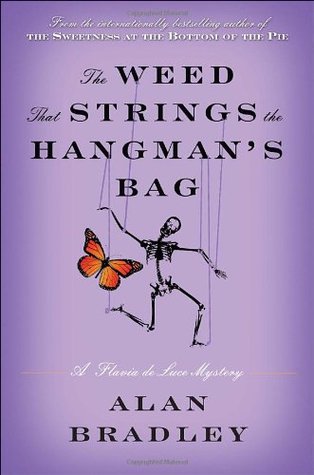
The Week That Strings the Hangman's Bag, Alan Bradley

Poor, Flave. Once again she's witness to a murder. At least this time she's not alone, though.

Charming and precocious Flavia deLuce is back in another murder mystery. This time, a puppeteer meets his untimely demise in front of half the town, in a production of Jack and the Beanstalk. Our favorite, pint-sized sleuth uses her strengths- wit, keen observation, and unquenchable curiosity- and her weaknesses to solve the puzzle.

It's an odd mystery that makes it almost halfway through before the murder occurs. A good bit of the character development of the less-than-angelic Mr. Porson takes place before he dies. Like preparing a good meal, Bradley seasons and salts the character after death.

Alas, the story itself is just not as good as the first. Usually I find that an author gets better within a series, but this is decidedly worse than The Sweetness at the Bottom of the Pie. As much as I looked forward to continuing the series, this one left me unimpressed. Flavia's connection to the story is weird and shallow. The mystery arc itself might have been good, but it doesn't relate to Flavia in even a suspension of disbelief-believable way.

Hangman only earns 2.5 Marias. Maybe I'll try another later.


Thursday, August 25, 2016

A Piece of Fanfiction


Where, oh, where do I begin? Since my thoughts on this book are so scattered, I'm going to try to put them down in an orderly, start-to-finish fashion. Let's hope I don't get sidetracked.

Ok, first. THIS BOOK IS NOT WRITTEN BY JOANNE NO-MIDDLE-NAME-BUT-THE- EDITORS-DIDN'T-THINK-BOYS-WOULD-READ-A-WOMAN'S-WRITING ROWLING. That's not entirely true. The people who wrote this lifted entire scenes from the real Harry Potter series, so that dialogue is consistent with the characters we know and love. The rest of the story- not even close. It's like they took the original stereotypes we had about them all, added 20 years, and never bothered to let them grow beyond Year One. Except Harry, who has turned into The Man, not the one you buy shots for- the one who keeps you down.

Back to that middle name thing- how in the world, did someone at a publisher, probably several someones, read The Philosopher's Stone, realize that it had great potential and not realize that it had Universal Appeal? I realize that boys are not encouraged to read about girls while girls are expected to read about boys and girls, but really? The first is filled with female characters that girls should get closer to- Macgonagall, Molly, HERMIONE. The whole idea that Rowling was forced to cloak her identity to protect poor little boys who might accidentally enjoy fiction by a woman just sets my feminism bone a-buzzin'.

Parts One and Two- this is not only unnecessary, it's false. I hate to be the Dwight Shrute here, but one could not read just Part One and have a complete story. They are dependent on each other to tell a whole story arc. There's a semicolon at the end of Part One, not a full stop. Also, none of the children are actually cursed, so the title is inconsistent with the rest of the stories.

Now into the actual pages. I cannot, for the life of me, figure out how this is a stage production. The scenes are so short and shift setting so often, you'd have to have the best set people in the world, possibly a rotating stage or a huge one. The huge one is probably how it happened because the characters don't move around while they are together or talking. So one huge background, lit the right, very focused way, could bounce around all over the magical world. I imagine it a very complicated production. In addition to the logistical nightmare, most of the scenes are so short there would have to be a lot of scrambling about on stage. One scene is a single page and doesn't contain a word of dialogue. And don't get me started on the actual magic that would have to occur. On stage. There's polyjuice, people.

The characters- what have they done to the characters we know? Macgonagall has lost her soft spot for Harry and the Gang. Headmistress must be a tough job if it crushes her spirit. Remember, she was a strict teacher, but she had a quiet, impish fire inside her. How did the woman who gave Harry his Nimbus 2000 come to merely tolerate him now that he's Head of Magical Law Enforcement? Was Ron lobotomized? Why doesn't Neville ever show up on stage? What has become of Teddy? WHERE IS HAGRID?

One of my favorite things to ponder is how the original stories would be different if Harry had accepted Draco's offer of friendship on the Hogwart's Express. Would Harry have become a Slytherin? (oh my goodness! it looks like this might be about that. Oh, wait, no.) What different path would he have taken to defeat Voldemort? Would the prophecy been about Neville instead? Would Ron and Hermione gotten together? Oh, the possibilities are endless! I got excited at the beginning of this book thinking that someone else had put pen to paper and drawn up one possible scenario, just one generation off. It starts with that premise a little bit- Albus is a Slytherin and friends with Scorpius, son of Draco- but that's about as far as that goes.

The story is unbelievable even when you suspend disbelief enough to accept magic. There are gaping holes. Is The Augury a bird, a child, or a place where they roast muggles? It is never referenced in the original novels, just in video games and later companion books. Now that Draco is out from under his father's thumb, why is he still a dickweed? Did he and Harry really not figure a way to be friendly in the twenty years since The Battle of Hogwarts? I could've sworn that a major theme of the series was redemption and forgiveness, I expect the hero to apply that to others, too. Why was Cedric's death so much more influential than any other person who died for The Cause? Did the writers fancy RPatz and wish him to not be sparkly?  And why hasn't Harry's scar been bothering him this whole time Voldemort's Child has been alive? Because it hurt him from the moment Moldy Voldy started sucking on unicorn blood in the first one. It wasn't that he was taking power and making efforts to destroy anyone, his mere existence was enough.

So despite all these complaints, I still liked the book. I was, once again, whisked away to a fantastic world where anything is possible, where good will triumph over evil, where people drink butterbeer. I think the writers, publishers, and producers were banking on that nostalgia to sell a truckload of books. We Potterheads will buy anything remotely related to Harry, Ron, and Hermione. We're still talking about the stories nine years after the last one was published. They are enchanting and magical themselves. After all these years? Always.

Being connected to the originals is enough to earn this one three Marias. I know many will argue I'm being sentimental, and I'm ok with that.


Tuesday, August 9, 2016

A Book That Makes No Sense


Orchids and Stone, Lisa Preston

I'm just making up categories now, so I figure I should try to make them entertaining. Unfortunately, entertaining is not how I would describe this book. It's pretty much the reason I cancelled my Kindle Unlimited membership. If this is the kind of drivel they are going to offer me for $10/month, I'd rather put that money towards stuff I can find at the used bookstore. Heck, I'll cut back on my Hardee's All Natural Low Carb intake and buy new releases to avoid crap like this if that's what it takes.

First, the title. Neither orchids nor stone play a vital role in the novel. Not only that, but they are never tied together. Of all the possibilities for titles (I suggest- Three Unrelated Stories, What's the Deal with Grandpa?, or maybe just What the F#$&), this one only makes sense because, like the different threads in the novel, they never connect enough to create one cohesive story.

The first thread is that this woman dropped out of college and became a roofer. She's pretty good at her job. Some dude on her first day wasn't thrilled that she could handle it. Spoiler alert- roofing is the only thing this woman seems capable of doing. She's a static character that never applies the life lessons thrown at her to actual life.

Then there's the thread of her murdered sister and her father's subsequent suicide. Talk about an anti-climactic resolution. Weak, weak, weak. I'll save you the trouble- the guy is dead.

There's also a thread about her relationship with her boyfriend and his two children. There are glimpses into the complications of blending families, but the children's behaviors go largely unexplained (and are somewhat inexplicable). Boyfriend's dad is also in a nursing home, which is probably supposed to help build tension but fails.

There's also the elderly woman in the park begging for help. Here's where the story really goes off the rails. It's kind of the main story except the narrator keeps coming back to these other, unrelated distractions. It's also ridiculously unrealistic. And the resolution to this conflict sucks just as bad as all the others. There is an attempt to link it to the murdered sister because Daphne (I finally looked it up for you) feels compelled to help the stranger and wishes someone would have done the same for her sister.

I think the biggest problem this book faces is trying to tackle too much with one book. There isn't enough to tie the different tales together (the only thing that does is Daphne, and I didn't really like her anyway). If Preston had focused on just one of the main themes- compassion/antipathy, surviving sibling of murder, family dynamics, workplace mysogyny- she could have come up with something readable with the right editor. Instead, we're stuck with a novel so bad that even the fact that it's "free" doesn't redeem it.

In short, don't waste your time. This book was a huge disappointment. One Maria.


Monday, August 8, 2016

Reading Aloud

I recently attended a webinar by Andrew Pudewa, founder of the Institute for Excellence in Writing, also known as "the funny man with the wonderful words." Mr. Pudewa is indeed a funny man who presents an engaging approach to teaching language arts at home and in the classroom. We are about to start our second year of IEW, but I'm not here to talk about homeschooling exactly.

The webinar was about how to develop a broad vocabulary in children, and one of the best ways to do this is to read aloud. Now, as a busy mom, I had kind of gotten to the point where reading aloud was losing priority because our oldest can read- he finished the Harry Potter series in a matter of days. Surely that is improving his vocabulary, right? Well, it turns out, just reading is not as magical as I would have thought. So, after about an hour with Mr. Pudewa (or just Pudewa as he is known around our house), I realized I needed to be reading aloud to all my children. And not just Go, Dog, Go for the zillionth time.

Next I was faced with the task of picking the best titles to read to three children, ranging from 3 to 8 years old, with a variety of interests. The oldest loves magical adventure stories, while the middle is easily frightened. The younger two don't flinch at death, while the oldest is compassionate. I wanted to include strong female characters, too. So from the bookshelf, I selected our first (even though we've done this before) Read Aloud:


The Lion, The Witch, and the Wardrobe, C. S. Lewis

Before I started reading, I explained to my daughter that this is one of my favorite childhood books. I told her that sometimes she reminds me of Lucy. I left out the part about pretending to be Lucy when I was a child, but it's true.

The story is not overly complicated. Four children stumble upon a magical kingdom where the White Witch has cast a spell that makes it always winter and never Christmas. The children meet talking animals and magical creatures on an adventure that lasts a lifetime or only a few seconds.

Girl-child is the only one who sat through the entire reading, but something I caught Oldest-boy standing in the hall listening in. Everyone followed the story well enough, even the 3-year-old. There were plenty of new words to absorb; I was occasionally stopped to define one. But overall, it was understood enough to make a story. There are, of course, subtleties in the writing (Spare Oom, for example) that the children will not appreciate until they read this one on their own. But we had fun reading it together- summarizing, making predictions, and imagining how we might find our way to Narnia.

As I mentioned before, this is one of my favorite childhood books, so it earns a permanent place on the bookshelf with (surprise) five Marias. But in addition to the rating, I want to encourage parents and teachers to read aloud, even to children who can read. It has made a subtle, positive impact on our days and is now one of the things I look forward to the most.