The Sparrow, Mary Doria Russell
A couple of years ago, I was reading the Outlander series and just had to take a break from it. I told my best friend that I just couldn't read about another rape. So I had picked up the Millennium Trilogy for a change of pace. I must give her credit for keeping a straight face, as I did not yet know that it also includes graphic rape scenes. She later recommended The Sparrow with the warning that it contains my "favorite topic." So I knew it was coming. And I knew a Jesuit was involved. And that made me a little scared to read it.
The first hundred pages or so seemed to drag on for me. It was all the buildup to the actual mission of first contact with a distant planet. There was, of course, some character development that had to happen here, but I just couldn't read more than a few pages before falling asleep. Once the ball started rolling, I became more interested, but it still took me more than two weeks to finish 400 pages. (Here I will point out that I often have difficulty beginning a new book after one that I really enjoy. So, this one suffered from my Stephen King Hangover.)
One thing I really liked about this book was the treatment of priests. I feel that oftentimes lay believers endow them with superhuman characteristics and non-believers find them easy to vilify. So I enjoyed the frank discussions of the humanity of the priests- their daily struggles with everyday life. I did not necessarily agree with the conclusions of some of the characters as to the best solution for those struggles, but I'm also not going to get into a dogmatic argument with a fictional person.
There were some things I found unsatisfying, too. The deaths of Sandoz' crewmates were anti-climactic. They were vicious and surprising, but they were all lumped together into two events, essentially. I think the tension would build better if the crew was picked off one-by-one. The pace is already hampered by the disjointed chronology, all leading up to The Big Reveal that is not surprising.
Overall, it was a good book that gave me plenty to think about regarding the stories in my head. It was accessible sci-fi, where I did not have to stretch my imagination too far to grasp the ideas. It is interesting to read it almost 20 years after publishing, too, because the radio signals that spawn the mission are discovered in 2016. I'll say this- if we do hear Singers from Rakhat next year, let's agree not to send the Jesuits. The Sparrow gets 2.5 Marias.
Saturday, May 30, 2015
Tuesday, May 12, 2015
Chapter 16: A Book That Made You Cry
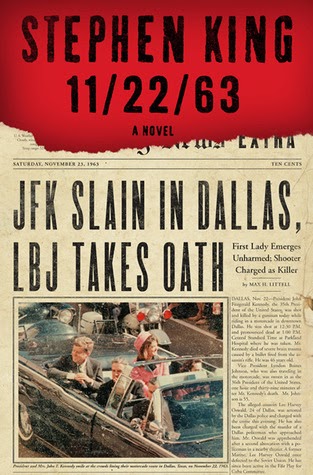
11/22/63, Stephen King
So much to say about this book. First, I don't think I've ever read anything by Mr. King. I remember a classmate in high school who read him almost constantly. He would carry one enormous volume after another on top of his textbooks and read them in stolen moments between classes. The sheer number of pages made me seriously question how he did anything else. Maybe that's why he was so thin. Anyway, John S. never convinced me to pick up a King novel, but my best friend and voracious reader, Elizabeth, did. She's never let me down in the entertainment category, so I checked this one out expected to cross A Book Your Best Friend Recommends off my list. As is becoming a theme here, it wasn't what I expected, and I had to shift from my original plan.
To be totally honest, I didn't actually shed a tear. But a few pricked up in my eyes, and that's about as close as it is going to get for me. I expected I would have to find a truly hilarious book that would make me laugh 'til I cried to accomplish this one. Instead, the man who brought me Carrie (one of my favorite movies of all time), nearly brought me to tears. He deserves credit for that.
Now, in order to get to the tears, we have to go back to what I thought the book was about. Even after reading the cover, I thought it was going to be about saving JFK from assassination. I thought it was going to be about an obsessed time-traveler. I thought it was going to be like one of many conversations I had in middle school with my friend, Stacey, who was so fascinated by the entire modern Camelot legend that she did an incredible re-enactment of Jackie's reaction in the convertible. I can't think of Jack and Jackie without also thinking of her. I was expecting Dealey Plaza to be the center of focus and action. I couldn't imagine why it would take eight hundred forty-some pages to tell the tale. And in walks the legendary Mr. Stephen King.
Having never read his works, I was unaware of his ability to drift on about mundane, daily life and still have it be meaningful. The impetus for Jake-turned-George's travel through the bubble of time may have been to save Kennedy, but his specific method requires him to always start on a fall day in 1958, in Maine. He has years to plot and tweak before he must end Lee Harvey Oswald. Most of the novel is about the man George becomes during this time. He's an English teacher, not a history buff, so he doesn't act as a pre-vigilante, saving the world from numerous disasters. No, after a couple of local "corrections," he lives a quiet life in a small town and falls in love with Sadie.
Sadie is the new librarian. George is a new teacher. They have troubles like any couple. They dance. They help students in life-changing ways, as teachers are apt to do (is someone chopping onions?). They share their biggest secrets and suffer tragedy (must be dusty in here). They love fully and boundlessly, and that is what made me almost weepy. Who knew the Master of Horror could pen a compelling, utterly romantic story?
There are a couple of graphic and gory scenes, but nothing like what I expected. This book took me by surprise in so many ways. I don't have a copy now, but I might keep an eye out for it at used book stores. I imagine I would enjoy it again and maybe pick up on strings I missed the first time. Even though it set me farther back on my schedule, it was worth every word. 11/22/63 earns 4 1/2 Marias.


Tuesday, April 28, 2015
Chapter 15: A Book That Came Out The Year You Were Born
I Am The Cheese, Robert Cormier
As you can probably tell by the publishing date of this entry, this book is a very quick read. All I can think now is how did I not read this in high school maybe even middle school? I have no answer to that question, but it seems I cheated my young self.
Cormier is known for his dark YA novels, even before they were called that. Cheese is no exception. On the surface, it's the story of a boy riding his bike to visit his father. Enter Brint. Brint seems to be some sort of psychologist who is intent on helping Adam fill in some blanks in his memory. Flashing between the epic bicycle journey and these guided sessions, we learn that Adam has bigger concerns than dogs and bullies. Below the surface, we enter the disturbed mind of a child protecting himself from a horrible truth. He so actively represses the memories that they are related in third person, giving us a distinction between past and present action. Normally I detest this type of jumping around (see Chapter 3c). I like a clear narrative. But Cormier makes it work to give an extra layer of tension to the psychological drama.
The ending seems to be the biggest or most common complaint about the novel, but I can't even dislike it. In fact, I think it's perfect. Any other ending would weaken the story (and I'd probably give it fewer Marias). So, while this won't become part of my permanent library, I probably will read it again. That alone is proof that it's better than Shutter Island, to which it is often compared. I Am the Cheese earns 4 Marias.
Monday, April 27, 2015
Chapter 14: A Book From An Author You Love That You Haven't Read Yet
The Julius House, Charlaine Harris
I love Charlaine Harris. The Southern Vampire (Sookie Stackhouse) series is hilarious, mysterious, and thrilling. Every time I read another, I feel like Charlaine and I could just sit on a porch with some iced tea and rocking chairs and chat all day long. In true Southern style, she writes outrageous stories that still pass cotillion. So, I picked up this title from one of her early series to see if Sookie and friends were the standard or the anomaly.
Now, to be honest, Sookie is just better. A lot of that is because the Aurora Teagarden series is a much earlier work. Roe is not as sassy as Sookie, but she still makes a fine female lead. This is not the first in the series, so maybe I've missed some foundation story that would have made Roe more likeable, but I still enjoyed it.
It's unlikely I will pick up this whole series. It didn't suck me in the way the other did. But I can see how it laid the groundwork for Ms. Harris' well-deserved popularity. Her writing has come a long way over the decades, and I am glad that first editor gave her shot.
If you like southern mysteries, strong female leads, and aren't put off by frequent mentions of money, check out this series. If you loved The Southern Vampires and are looking for more of the same, find a more current series. This one is dated and immature compared to Sookie. Overall, I give it 3 Marias. I won't read it again, but I don't hate myself for reading it the first time.
Thursday, April 23, 2015
Chapter 13: A Book With Magic
Queen of the Tearling, Erika Johansen
This book has a lot to like- strong female lead, mystery and intrigue, political philosophy, and a healthy dose of profanity. Now, I'm not going to pretend that it comes close to competing with The Books With Magic. Kelsea is no Boy Who Lived. But this is a good book.
My biggest gripe with this book is that it is difficult to find a place to stop. Not because the action is so compelling, but because of 434 pages, there are only 14 chapters. Let me do the math for you, that averages out to some longass chapters, and they are not broken down into pieces. That's it. That's my big complaint. That and I can't decide whether it's pronounced Teerling, rhymes with peer, or Tairling, rhymes with pair.
I also got tired of reading Kelsea hiss when she was hurt. And I really didn't need reminders that Thomas is fat. Or that Kelsea is. But ... meh.
I did like that not all my questions were answered. This is a good opening to a series that has potential. I think some of the more shocking events were supposed to take me by surprise, but there was enough foreshadowing, that they just confirmed what I already suspected. So, either Ms. Johansen and I think alike, or she did an artful job of crafting peaks without then telling us
*** HEY, HERE'S A RISE IN CONFLICT! ***
What? You don't like that, either? I might still be a little mad at Zusak.I also really like the setup for the hero. She is naïve yet educated. Her sheltered childhood gives her an interesting position from which to examine her kingdom in a way unlike many royals. Of course she is inheriting a decimated kingdom from her gluttonous uncle, but she sweeps in to rule with a new attitude. It's interesting to watch her develop as a leader and discover more about herself along the way.
I can't talk about liking this book without also mentioning her captain, Mace. He's your standard, world-weary tough guy that no one wants to take on. He's brusque when he's not silent, but he's also lovable and admirable. His name is also Lazarus, so I expect to see something done with that in future installments.
So, this is a good one. I might even read it again if I really get into the series (a new one is out this summer). It won't be in my permanent library. And I don't daydream about all the homeschool activities we can do when the kids read it (Seriously, think about how the Harry Potter series would differ if he accepted Draco's friendship in book one. Think about it.). I give it four Marias.
Monday, April 13, 2015
Chapter 12: A Book That Became A Movie
The Book Thief, Markus Zusak
I want to like this book. Really. It's got drama and books, the pages are filled with the complexities of human existence. But ... meh.
*** A VERY IMPORTANT NOTE ***
I'm about to tell you something very important. And I will use a wort, or word.
This gimmick is old. Boring. Redundant. Annoying. It makes me want to punch Death in the grapes.
I have to give Zusak credit for taking on a much-visited topic, Germany during World War II, from a less-used position, that of Death. And the core story arc would be compelling if it were readable. But instead we have a stuttering telling of a young girl in a poor home in Germany. She meets people. She cares for people. She helps hide a Jew in the basement. Everyone calls each other asshole. Everyone has nightmares. Everyone dies.
I'm going to attempt to discuss a few key points in an orderly manner, but having had my brain scrambled by this book, I beg your pardon if it comes out jumbled.
First, Death as narrator. This isn't a completely novel approach to storytelling (see what I did there?). At first I actually enjoyed reading the buildup of Nazi Germany from a non-human point of view. But, ugh, the gimmick. The flow is disrupted by those stupid boldface interjections of no value. And for a mostly indifferent persona, death sure uses a lot of indicators of extreme emotion. But to what end? To tell us what he's about to tell us.
Second, the book thief. Ok, let's start with the fact that she only technically steals one book in the whole story. One she picks up after someone drops it. Another she rescues from a pile of smoldering ashes. And, after she steals the one book, the owner starts leaving more for her to "steal." So, she doesn't seem very worthy of this title. And as the story progresses, you learn that Death, too, has picked up a book someone left behind. So he's a book thief too! Oh how clever! Not.
Then, the characters are not well developed. Hans has silver eyes. Rosa is a wardrobe of a woman with a cardboard face (whatever the heck that means). Liesel loves papa. Rudy loves Liesel. Max is a Jew. They are flat and they do incredibly foolish things. I think some of these instances, like giving bread to Jews as they are marched to Dachau, are supposed to illustrate the humanity of the main characters, that they really do love and care and pity the victims of the Holocaust. Except that giving them bread is sure to bring more suffering to the people- beatings or worse. So it seems, to me, that these are essentially selfish acts to alleviate some guilt of not acting sooner. It's certainly no black-and-white dilemma, but Death sure thinks it is. Over and over, acts of love bring more misery and death to the objects of that love. Death is kind of an asshole.
The tempo and chronology was the most troublesome for me. There isn't so much a foreshadowing of events as there is a sentence or two telling you something is going to happen. Then Death backs up (sometimes months) and finally brings you back to the original sentence. Again, it's gimmicky and tiresome. After everyone died, I kept reading and they were alive again. It took a big mental shift to figure out where in time I was. And then I leapt forward again. And literally the entire book is like this because the first sentence is that everyone dies. But the story doesn't end there. Oh no! We have to revisit the deaths a few times before Death finally wraps the whole thing up.
My big question about this novel is- what makes it Young Adult? Yes, Liesel is eight years old when it begins, but that doesn't seem quite enough. Teens these days are unlikely to even know a person who remembers WWII, so the specific story doesn't seem all that relatable. The major tensions of the book are not ones that exist in everyday life, at least not in the same way that other YA books I've read do. Maybe it's just another way to keep the realities of WWII Germany in current conversations. If so, it seems to be doing that. My teenage niece loves this book. I doubt she saw Schindler's List or Life Is Beautiful.
Overall, I'm pretty ambivalent about this novel. It didn't give me a case of the Feels. It wasn't new territory or groundbreaking insight. Nor was it really entertaining. But the context for the target audience and for effort alone, I give The Book Thief 2 Marias.
I'm going to attempt to discuss a few key points in an orderly manner, but having had my brain scrambled by this book, I beg your pardon if it comes out jumbled.
First, Death as narrator. This isn't a completely novel approach to storytelling (see what I did there?). At first I actually enjoyed reading the buildup of Nazi Germany from a non-human point of view. But, ugh, the gimmick. The flow is disrupted by those stupid boldface interjections of no value. And for a mostly indifferent persona, death sure uses a lot of indicators of extreme emotion. But to what end? To tell us what he's about to tell us.
Second, the book thief. Ok, let's start with the fact that she only technically steals one book in the whole story. One she picks up after someone drops it. Another she rescues from a pile of smoldering ashes. And, after she steals the one book, the owner starts leaving more for her to "steal." So, she doesn't seem very worthy of this title. And as the story progresses, you learn that Death, too, has picked up a book someone left behind. So he's a book thief too! Oh how clever! Not.
Then, the characters are not well developed. Hans has silver eyes. Rosa is a wardrobe of a woman with a cardboard face (whatever the heck that means). Liesel loves papa. Rudy loves Liesel. Max is a Jew. They are flat and they do incredibly foolish things. I think some of these instances, like giving bread to Jews as they are marched to Dachau, are supposed to illustrate the humanity of the main characters, that they really do love and care and pity the victims of the Holocaust. Except that giving them bread is sure to bring more suffering to the people- beatings or worse. So it seems, to me, that these are essentially selfish acts to alleviate some guilt of not acting sooner. It's certainly no black-and-white dilemma, but Death sure thinks it is. Over and over, acts of love bring more misery and death to the objects of that love. Death is kind of an asshole.
The tempo and chronology was the most troublesome for me. There isn't so much a foreshadowing of events as there is a sentence or two telling you something is going to happen. Then Death backs up (sometimes months) and finally brings you back to the original sentence. Again, it's gimmicky and tiresome. After everyone died, I kept reading and they were alive again. It took a big mental shift to figure out where in time I was. And then I leapt forward again. And literally the entire book is like this because the first sentence is that everyone dies. But the story doesn't end there. Oh no! We have to revisit the deaths a few times before Death finally wraps the whole thing up.
My big question about this novel is- what makes it Young Adult? Yes, Liesel is eight years old when it begins, but that doesn't seem quite enough. Teens these days are unlikely to even know a person who remembers WWII, so the specific story doesn't seem all that relatable. The major tensions of the book are not ones that exist in everyday life, at least not in the same way that other YA books I've read do. Maybe it's just another way to keep the realities of WWII Germany in current conversations. If so, it seems to be doing that. My teenage niece loves this book. I doubt she saw Schindler's List or Life Is Beautiful.
Overall, I'm pretty ambivalent about this novel. It didn't give me a case of the Feels. It wasn't new territory or groundbreaking insight. Nor was it really entertaining. But the context for the target audience and for effort alone, I give The Book Thief 2 Marias.
Wednesday, April 8, 2015
Chapter 11: A Book That Takes Place In Your Hometown
I'm only 11 entries in and I'm already fudging a little bit. The nice thing about being a nomad for the majority of your life is that you can claim a number of places as home. Lucky for me, I had a kindle book set in Chicago and I once had an address in the City of the Big Shoulders. Because, let's be honest, there are not a lot of interesting books taking place in Tupelo, MS or LaPorte, IN. Yet. And there are too many titles in Los Angeles. I did once read a mystery set in High Point, NC, but I'm not ready to re-read for this journal. Yet. So, I opened up this one that I got as a freebie.
I'm not even sure how or why I got this one for free, but it is much better than many other freebies I have read stared at. I think calling it a smart romance might be a stretch, but that is far more accurate than calling this series "Knitting in the City." The main character doesn't even knit! She goes to her friend's knitting group three times in the whole book, mostly just for girltalk. There is brief mention of projects-on-needles and a ball of MadTosh, but if the rest of the series is about Janie, the publisher should seriously reconsider the series name. Maybe Awkward Girl in the City.
We meet Janie on the Worst Day of Her Life. She broke up with her cheating boyfriend, got fired, and now has nowhere to live (see cheating boyfriend). She takes her meager possessions to her friend's apartment for alcohol and ice cream. They talk about the most important event of the day- riding in an elevator with a hot security guy. Like many overzealous crushes, this one has been knighted Sir (Something-Something) Hotpants. Really, it's so dumb I can't be bothered to remember or look it up. But these are young, single women and I can't pretend I didn't suffer my own boy crazy phase.
Except Janie is not really the boy crazy type. She's a Curator of Fact with a dysfunctional mental/verbal filter. She doesn't recognize obvious flirting and innuendo. She is not social. She also repeatedly talks about how ugly and monstrous she is. Yeah. Big boobs and long legs are gross. Despite all this, her friend takes her to an Outrageous night club where people are fornicating in glass cages. I'll let you guess who happens to be working security there, too. It's Hotpants. Are you gobsmacked? Janie sure is.
From here, all other characters are peripheral and we watch a bizarre courtship between the two. So many things make no sense at all. It is so incohesive and implausible. I kept waiting for The Thing that brings it all together, but it never appeared. And then the resolution (if that's even the right term) comes out of nowhere and ends abruptly. I am still so disoriented, that I have no interest in reading more of the series because I do not care about any of the characters. Plus, THERE'S NO KNITTING!
What did I enjoy? Hotpants (whose name is Quinn Sullivan and can never be separated in my mind from this guy)
sends Janie nerd jokes via text. I chuckled at the binary one. I also found some of the facts Janie blurts out at inappropriate times to be interesting, although I still need to check some of them. (Here is where I'd like to point out that being able to recite things from memory is not exactly the same thing as smart. It can be if one can then apply it to appropriate situations, but Janie can't.) And I like that, despite having some sparky bits, it doesn't go into detail about all the humping. Which brings me to a tangent.
At one point, Janie's friend (I'm sure she has a name, but she's totally forgettable) says that she knows Janie didn't like sex with her ex-boyfriend because she never talked about it. This has been running around in my brain for days now. Maybe it's the difference between married and singles sex. Maybe it's an age thing. Maybe my friends and I are all prudes. But I just don't witness many conversations about sex. I'm not really interested in grabbing a margarita with a gal pal and exchanging play by plays of our most recent romps. This leads me to believe that I'm not really the target audience for this series. There are worse things in life, I suppose.
So I've been trying to come up with a rating system for this journal- a way to quickly see what I liked and didn't, what I recommend you pick up or burn. So far nothing has really been quite what I am looking for, but a friend suggested this.
So until I come up with something better, which I may never do, I give Neanderthal 2.5 Marias. It was easy to read, didn't take much time or gray matter, didn't make me fall asleep, nor did it make any sense. I won't read it again or continue the series, but I don't hate myself for reading the whole thing, and I won't be sending glitterbombs to the author.
Subscribe to:
Posts (Atom)